सीपीएम की क्रांति

सीपीएम की क्रांति
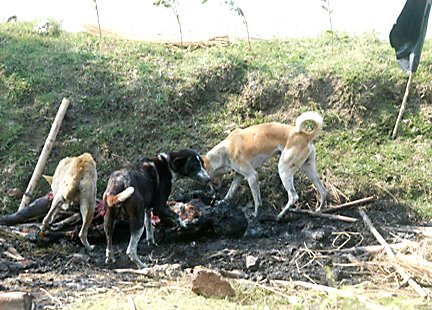
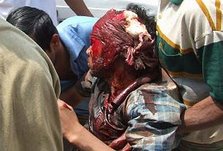
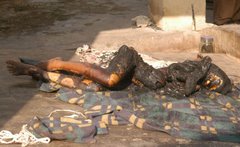
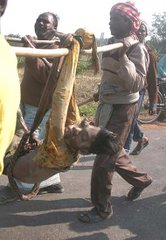
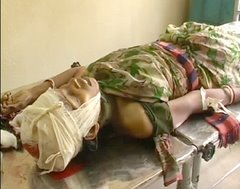
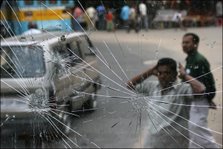
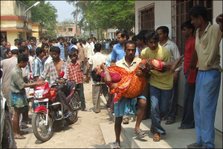
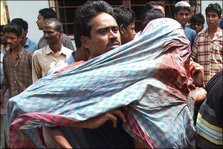
हम एक लोकतंत्र में रह रहे हैं! 14 मार्च को हुई घटना और उसके बाद सीपीएम के बंद के दौरान गायब हुए दो सौ लोगों का अब तक कोई अता-पता नहीं है्. हां। कुछ लाशें हैं जो इलाके में इस हालत में पायी गयी हैं. क्या हम बता सकते हैं कि इन्होंने किस बात की कीमत चुकायी? क्या हम इसको लेकर आश्वस्त रह सकते हं कि हमें भी कभी ऐसी ही कीमत नहीं चुकानी पड़ेगी?
Showing posts with label खबर. Show all posts

Friday, April 6, 2007

London protest against West Bengal killings calls for scrapping of the SEZ Act

London protest against West Bengal killings calls for scrapping of the SEZ Act

Nearly 50 people gathered outside the Indian High Commission in London on 2nd April 2007 in an angry protest against the Nandigram killings which took place on 14 and 15 March when a 5,000 strong contingent of police opened fire on local people resisting forcible eviction from their land which was to be turned into a Special Economic Zone (SEZ).

The true scale of the atrocities which occurred in the operation, planned at least a week in advance by the CPI(M) led West Bengal government, is now
emerging. TV footage showed trucks carrying bodies with their legs dangling out. More than 50 people are missing from the terrorised villages of Nandigram, and believed dead. Human rights activists report that women were gang-raped, children brutally attacked, and that there are large numbers of young girls and children among the “disappeared” in the targeted villages.

The demonstrators shouted slogans such as “Nandigram, Never Again! Scrap the SEZs!” and held the West Bengal Chief Minister Buddhadeb Bhattacharya responsible for the carnage, chanting “Buddhadeb, Shame, Shame! So many killings in your name”. One of the placards read “West Bengal government murdering for big business”.

The organisers of the protest, the Transnational Institute, South Asia Solidarity Group and Reading Grassroots Action, also handed in a letter to the President of India, urging him to ensure

1) A thorough independent enquiry and the prosecution of all state officials, including police personnel, who are suspected of perpetrating human rights violations

2) Full medical attention for those injured who have yet to receive proper care

3) The immediate suspension of the SEZ Act of 2005.

They also expressed concern about the proposed ‘chemical hub’ SEZ near the port of Haldia. The main transnational corporation showing interest in this new SEZ is Dow Chemicals, manufacturers of ‘Agent Orange’ who were major suppliers of chemical weapons for use in Vietnam. There are major
concerns about pollution: chemical factories need special environmental clearance (Environmental Impact Assessment) which was not sought for Nandigram and is also likely to be bypassed in Haldia.

A spokesperson for South Asia Solidarity Group, Kalpana Wilson, said, “The British government’s policies and aid to the government of West Bengal
and other states in India are promoting SEZs, vast enclaves which are virtually foreign territories controlled by transnational corporations, making thousands of people destitute. We plan to step up the campaign against this.”

Smaller, kinder SEZs

Smaller, kinder SEZs
- Bengal projects survive ceiling but land consent must

New Delhi, April 5: The Centre today said land for special economic zones must be acquired with the consent of owners and put a 5,000-hectare cap on their size.

The ceiling will not affect projects in Bengal, where the largest proposed is the Salim Group’s multi-product SEZ to be spread across 5,000 hectares (12,500 acres). Reliance’s 10,000-hectare Maha Mumbai SEZ and another in Haryana will, however, be hit.

“The state governments are free to lower the cap for SEZs below the 5,000-hectare mark if they want to,” commerce minister Kamal Nath said, pre-empting protests from the Left, after the empowered group of ministers lifted the freeze on SEZs imposed in January amid controversy over land acquisition.

The CPM, which had sought a 2,000-hectare cap, was however not complaining about the higher ceiling. “It will help us to go for the proposed chemical hub,’’ Bengal secretary Biman Bose said in Calcutta.

The chemical hub is the 10,000-acre SEZ planned by the Salim Group in Nandigram, which is now expected to come up in Haldia. Had the party’s demand for a 2,000-hectare (5,000 acre) ceiling been met, both the Salim projects would have had to be curtailed. The chemical SEZ might yet be made smaller because Haldia does not have enough land.

“No state can compulsorily acquire land (for an SEZ) from farmers through the Land Acquisition Act,” Nath said, adding that the promoters would have to buy from owners willing to sell, at the market rate.

However, little prevents a government from acquiring land under the act, citing public purpose for which no consent is required but without specifying the use. It can later be handed over for an SEZ.

“It appears that some of our demands have been met,” Bose said, pointing to the decision to raise the minimum processing area to 50 per cent in all SEZs, in line with Bengal.

So far, the 50 per cent cut-off was limited to sector-specific SEZs while in the multi-product projects, only 35 per cent of the area needed to be allocated for processing (the core activity). Even this could be reduced to 25 per cent with special permission.

The low cut-off had come under fire from the Left which alleged promoters were availing themselves of the tax concessions meant to push productive activity but using most of the land for realty projects.

What Bose did not mention was that another demand of the CPM was ignored. The party has been seeking a curb on the tax concessions given to SEZs, but the sops continue.

A rehabilitation policy is being framed which would ensure livelihood from the project to at least one person from each displaced family, Nath said. “The new norms would be applicable to all SEZs, including those already notified.”

But commerce and industry secretary Sabyasachi Sen said a job for each family would be difficult in Bengal, where holdings are “small”.

Eighty-three SEZs that had been approved by the commerce ministry and did not face a land dispute were cleared today by the group of ministers. Among the projects that will be notified now are the Jindal SEZ in Kalinga Nagar and Infosys in Pune.

Smaller, kinder SEZs

Smaller, kinder SEZs
- Bengal projects survive ceiling but land consent must

New Delhi, April 5: The Centre today said land for special economic zones must be acquired with the consent of owners and put a 5,000-hectare cap on their size.

The ceiling will not affect projects in Bengal, where the largest proposed is the Salim Group’s multi-product SEZ to be spread across 5,000 hectares (12,500 acres). Reliance’s 10,000-hectare Maha Mumbai SEZ and another in Haryana will, however, be hit.

“The state governments are free to lower the cap for SEZs below the 5,000-hectare mark if they want to,” commerce minister Kamal Nath said, pre-empting protests from the Left, after the empowered group of ministers lifted the freeze on SEZs imposed in January amid controversy over land acquisition.

The CPM, which had sought a 2,000-hectare cap, was however not complaining about the higher ceiling. “It will help us to go for the proposed chemical hub,’’ Bengal secretary Biman Bose said in Calcutta.

The chemical hub is the 10,000-acre SEZ planned by the Salim Group in Nandigram, which is now expected to come up in Haldia. Had the party’s demand for a 2,000-hectare (5,000 acre) ceiling been met, both the Salim projects would have had to be curtailed. The chemical SEZ might yet be made smaller because Haldia does not have enough land.

“No state can compulsorily acquire land (for an SEZ) from farmers through the Land Acquisition Act,” Nath said, adding that the promoters would have to buy from owners willing to sell, at the market rate.

However, little prevents a government from acquiring land under the act, citing public purpose for which no consent is required but without specifying the use. It can later be handed over for an SEZ.

“It appears that some of our demands have been met,” Bose said, pointing to the decision to raise the minimum processing area to 50 per cent in all SEZs, in line with Bengal.

So far, the 50 per cent cut-off was limited to sector-specific SEZs while in the multi-product projects, only 35 per cent of the area needed to be allocated for processing (the core activity). Even this could be reduced to 25 per cent with special permission.

The low cut-off had come under fire from the Left which alleged promoters were availing themselves of the tax concessions meant to push productive activity but using most of the land for realty projects.

What Bose did not mention was that another demand of the CPM was ignored. The party has been seeking a curb on the tax concessions given to SEZs, but the sops continue.

A rehabilitation policy is being framed which would ensure livelihood from the project to at least one person from each displaced family, Nath said. “The new norms would be applicable to all SEZs, including those already notified.”

But commerce and industry secretary Sabyasachi Sen said a job for each family would be difficult in Bengal, where holdings are “small”.

Eighty-three SEZs that had been approved by the commerce ministry and did not face a land dispute were cleared today by the group of ministers. Among the projects that will be notified now are the Jindal SEZ in Kalinga Nagar and Infosys in Pune.

Fresh violence at Nandigram

PTI[ FRIDAY, APRIL 06, 2007 07:57:13 PM]
Nandigram: Fresh violence erupted here on Thursday as CPI-M and Bhumi Ucched Pratirodh Committee supporters exchanged fire and hurled bombs at Paharganj, an area between Nandigram Block-I and Khejuri.
East Midnapore Superintendent of Police G A Srinivas told PTI that both sides used country made guns and bombs for an hour since noon at Paharganj.
None was injured.
The police intervened and restored order, he said, but tension was running high.
Bhumi Ucched Pratirodh Core Committee member, Abu Taher alleged that the CPI-M suppporters fired 15 rounds and threw a dozen bombs from their stronghold at Khejuri.
He claimed that a number of CPI-M supporters visited the Committee office this morning, saying they wanted to join the committee as their party had yesterday held a meeting at Kunjapur, where it was proposed to collect signatures in favour of land acquisition. This led to the violence, he added.
Yesterday, the Committee had complained to the Nandigram police station that five of its members were assaulted by CPI-M supporters at Tekhali bazar of whom three had to be admitted to the Nandigram primary health centre.
Fourteen people were killed in police firing at Nandigram on March 14, as people resisted the police from entering the villages.
Earlier, seven people were killed on January seven after violence broke out on rumours that land would be acquired for a SEZ. The Buddhadeb Bhattacharjee government has formally announced that the SEZ would not be set up in Nandigram and shifted elsewhere in the district.

Wednesday, April 4, 2007

Comrades in alms

In a world swept by huge changes, a lifestyle held hostage to small change

The Red star has faded, and the dream of revolution it inspired now seems like a quaint idea from a worn book.

New currents have swept away many of the cobwebs in the Indian communist’s mind and turned some old enemies into new allies. Yet for the Marxist, his dues to history are more easily paid than his personal bills.

So, while BJP and Congress MPs can be seen chilling out at Barista cafes or dining at five-star hotels, their colleagues from the Left can at best afford the Kakeda or the National at Delhi’s Connaught Place.

For, one thing hasn’t changed since the time when the Soviet Union was a superpower and university students carried the Little Red Book rather than iPods. The party’s tight leash on members’ wallets shows no sign of withering.

In the good old days, many Indian communists, their whole life dedicated to building a classless society, lived in Spartan communes and ate at a common mess. Most of their elected leaders, too, wore their austerity like a badge.

The high tide of consumerism has made that “radical” lifestyle unfashionable. The communists and their leaders are no longer squeamish about being spotted at fast food joints or in cars other than Ambassadors or Fiats.

Or are they? A few years ago, a CPM member of Parliament caught eating at Nirula’s near the party headquarters in Delhi had launched into a lengthy explanation about how he had been starving since that morning.

His embarrassment was hardly surprising. The CPM stays ever alert against its MPs or “whole-timers” being seduced by the lure of the “bourgeois lifestyle”.

So, when MPs’ salaries rose from Rs 26,000 to Rs 42,000 a few months ago, the party decided to shield them from the luxury of having money to spare — the root of all temptation.

It laid claim to the entire Rs 16,000 hike, raising MPs’ stipulated donation to the party fund from Rs 19,000 a month to Rs 35,000.

This leaves the MPs with Rs 7,000 — like before — to buy their groceries, pay their children’s school fees, run a second establishment in their constituencies and foot their travel bills.

The parliamentarians are not complaining, at least in public. “When you join the communist party, you know you cannot live a life of luxury,” a party MP said.

So how do they get by?

It’s the daily allowance of Rs 1,000 they are entitled to during Parliament sessions, plus what they get for attending House committee meetings, that tide them over.

“In all, it comes to Rs 20,000-25,000 a month,” an MP said. “Also, don’t forget that the wives of most MPs work.”

Life would still have been difficult had it not been for the highly subsidised food and travel they are entitled to.

“We pay a nominal charge for accommodation and electricity. In Delhi, we can make one lakh free phone calls, which is more than enough,” the MP said.

But once they are in their constituency, the MPs must pay for their travel and phone calls.

The Marxist’s choice of tipple, therefore, tiptoes cagily between Old Monk and Royal Challenge, generally giving wines a wide berth. The preferred puff, however, ranges from the bidi to Wills/Gold Flake to even Dunhill/Marlboro, being easier on the pocket.

There is no single kind of school where the Left MP sends his children. Hannan Mollah and Yechury picked Sardar Patel Vidyalaya, a reputable public school. Many others settle for central schools.

Mohammad Salim’s children, though, studied at Calcutta’s Patha Bhavan till Class X. They did their Higher Secondary from a village school in Udaynarayanpur, Howrah, because Salim wanted his children to get a taste of rural Bengal. The MP’s eldest son is now at Bengal Engineering and Science University, Shibpur.

Yet it’s not just the need to count his pennies that keeps the Leftist away from the Page 3 lifestyles of many of his peers from other parties — and from flashy cars, five-stars and Fab India kurtas (Sitaram Yechury is an exception). The aam admi’s champion is touchy about image.

So last year, when CPM boss Prakash Karat and his wife Brinda, also a politburo member, travelled to Europe on a holiday the party simply clammed up on the destinations they were expected to visit.

Yet the MPs are far better off than the whole-timers. They are the tribe of tireless workers who often braved official persecution, left their families and worked from the underground to make the CPM what it is today.

There is neither subsidy nor travel concession for them. A whole-timer in even a “good” (CPM-ruled) state like Kerala or Bengal cannot hope to earn more than Rs 4,000.

Last September, Karat had announced that the full-time activists “will be paid the minimum wage of an unskilled worker”. According to the National Rural Employment Guarantee Act, this is either Rs 60 or the state minimum wage, whichever is higher. Kerala and Bengal have minimum wages of Rs 130 and Rs 79.

But in states like Rajasthan and Bihar, the party whole-timers are worse off than unskilled workers on the minimum wage. They are paid less than Rs 60 — and often not at all.

Which, perhaps, is why the full-time workers — the backbone of any communist party — are in short supply just when the CPM is making its presence felt in national politics and its overall membership is rising. The party’s last political organisational report expressed concern at this.

Many would see in the trend a sign of the times when the romantic call to rebellion can no longer inspire the youth to a life of sacrifice.

The party report, however, skirted the big picture as it laid down the dos and don’ts for the cadre with an apparatchik’s obsession for ritual.

“They should lead a communist life,” it said. “They must not accept gifts and compliments from others.”

Charred body in Nandigram ashes

No clue to victim identity

Midnapore, April 1: Tension mounted in Nandigram today after members of the Bhoomi Uchchhed Pratirodh Committee recovered the charred remains of a body from a heap of cinder on the outskirts of Sonachura village.

The major part of the body was buried under ash and the other portion was a little away.

The headless body, reduced virtually to charcoal, was taken to the Nandigram police station in a cycle van.

“The body is so badly burnt that it is not even fit for a post-mortem. We can’t say for sure whether it is that of a man or a woman or how old that person was. A forensic test can tell that,” said Nandigram block medical officer Subhabrata Maity.

Western range inspector-general Arun Gupta said all that the police received was a charred bundle of bones. It has been sent for forensic examination.

The Pratirodh Committee took out a procession this morning to demand Buddhadeb Bhattacharjee’s “punishment” for the police firing that killed at least 14. Columns of protesters, which included women and children, snaked from Garchakraberia to Sonachura — the sites of the March 14 bloodbath — and dispersed on seeing a large posse of policemen on the outskirts.

Some of the people then marched towards the other side of Sonachura, where they found the body near Sankar Samanta’s house.

A mob opposed to land acquisition had battered to death Sankar Samanta, a CPM-supported member of the Nandigram panchayat, on the night of January 6. They had also set fire to his house.

After the body was found, the Committee members set fire to Samanta’s abandoned house.

Another mob went towards the Bhangabera bridge and dug up the road, which was repaired after the police moved in on March 14, at five places.

The Committee could not tell the police whose body it could be. However, they were sure that it was one of those “murdered jointly by the police and CPM cadres”.

“They murdered many of our supporters. Many of our people are still missing,” said Abu Taher, a Trinamul leader.

Although the committee has claimed that 27 of its supporters are missing since March 14, no complaint has been lodged with the police.

Pranab Samanta, father of 24-year-old Subrata, moved Calcutta High Court on Friday, saying his son went missing after being hit by a police bullet on March 14. “I saw my son fall to a police bullet. That was the last time I saw him. His name does not figure on the lists of the dead, injured or missing,” he said in the petition.

According to the police, Durgapada Maity, 42, who is said to have gone missing on March 14, actually cannot be traced since March 4.

“There was a report from Nandigram that Durgapada was killed while making bombs. When then Nandigram officer-in-charge Shekhar Roy went to his house at Raynagar, his wife Amita told him he had gone to South Khali on work. The OC had asked Amita to send her husband with his photo I-card to the police station the following day, but he never turned up. He is missing since,” a police officer said.

Tuesday, April 3, 2007

PAMANGGAS condemns Nandigram massacre, Italian Metal Unions react to Singur

PAMANGGAS condemns Nandigram massacre, Italian Metal Unions react to Singur

Philippines - The PAMANGGAS (Panay Guimaras Peasant Solidarity) strongly condems the massacre of 14 farmers in Nandigram, West Bengal, India by the Indian police force.

The farmers, needs land and food. It is a horrible thing that instead of hearing their just demand the governmnent of India answers it with guns and bullets. This barbaric act of indian military police is not suited in this civilized world. It deserve world-wide condemnation.

It has shown that the government protects not the farmers but the multinational corporations who want to invest in the special economic zones of West Bengal. It is disgusting that while the governmnent is claiming that special economic zone will bring prosperity to the people of West Bengal and india in general farmers of india are massacred to stablish that economic zone.

We, peasants of Panay and Guimaras, Philippines are in one with the call of farmers and people of Nandigram, West Bengal’s call for justice! We must be strong in our struggle.

Let the blood of our peasant martyrs be a fire to lighten our way towards liberation.

Onward peasant struggle for genuine agrarian reform!

Fight for our food sovereignty!
Fight government Fascism!
Fight US imperialism.

Nilo Arado
Pamanggas

Italian Metal Unions Condemn Rights Violations in West Bengal, Call on Carmarkers to Move Plant from Singur
Posted to the IUF website 14-Mar-2007

The three Italian unions representing workers at Fiat, the multinational carmarker involved in joint production with the Indian conglomerate Tata - have called on Fiat management to take action to move the site of the planned small car plant in Singur, West Bengal. The plant would employ 2,000 workers, while up to 30,000 people will lose their land and livelihood, including agricultural labourers, marginal peasants, sharecroppers, cottage industry and other rural workers who would receive no compensation under the procedure. Strong resistance to the plant construction has been mounted by thousands of workers and small peasant farmers, supported by the IUF affiliate PBKMS.

Police repression and violence against the villagers has intensified, with 5,000 additional police recently deployed in the area.

The FIAT unions’ joint statement condemns the repressive measures taken against residents resisting the auto project and calls on both FIAT and TATA to press the West Bengal government to find an alternative site for the project which will not threaten local food production. The full text of the statement is available on the website of the International Metalworkers’ Federation here.

Show of solidarity: Kalingnagar activists visit Nandigram

Activists from Orissa's Kalingnagar paid a visit to Nandigram on Tuesday to express solidarity with the villagers in their battle to protect their land from big business.

Last January, 13 people died in police firing at Kalinganagar while protesting land acquisition for a Tata project.

Fourteen died in Nandigram earlier this month while resisting acquisition of land for a SEZ.

The two villagers shared experiences and on the threat of losing their land to big business and the loss of lives while trying to defend their land. Both in Kalinganagar and in Nandigram the fight is for land.

But the difference is, the political consciousness of the people here is much higher than the people of Kalinganagar," said Ravi Jarika, Kalinganagar Bisthapan Birodhi Manch.

On Monday, the 45 Kalinganagar activists were detained for 12 hours by the West Bengal police at Kharagpur as suspected Maoists come to whip up tension at Nandigram.

"It is still agriculture that gives maximum employment and ensuring food security. This people don't want to disturb because there is no alternative. And alternatives can come only through small and medium industry and not big industry as they are forcing now," said Rajendra Sarangi, Lok Pakshya.

Debate rages

As the debate rages, the Nandigram-Khejuri border remains taut with tension.

Sonachura, under the Bhoomi Uchched Pratirodh Committee's control, has dug up roads afresh, apprehending attacks from CPI-M dominated Khejuri and vice versa.

"It has been more than 10 days now. But every day they is firing in the evening. People living on the border can't stay there at night," said Nishikanta Mondal, Bhoomi Uchched Pratirodh Committee.

"Last night they burst bombs at Sonachura. Sometimes, they come in groups and shout that they will destroy Khejuri," said Debu Das, Khejuri resident.

Two weeks after the killings in Nandigram, peace and normalcy still remain elusive.

CPI(M) admits mistakes in Nandigram

Under fire from its detractors over the Nandigram incidents, the CPI(M) asked its West Bengal unit to examine what went wrong as it admitted that "some mistakes" have been committed while handling the affair.

The three-day meeting of the party's Central Committee, the first after the police firing, deliberated the issue and concluded that it was unfortunate that ordinary people have died in the violence which should not be repeated again.

"The Central Committee has noted that some mistakes have been committed in the handling of the affair as stated by the Chief Minister (of West Bengal)," said party General Secretary Prakash Karat.

Asked what were the mistakes and who was responsible for it, he did not to give a direct answer and just said "there are various mistakes and some of which are committed by the government."

Although Chief Minister Buddhadeb Bhattacharya has already taken responsibility for the incidents in Nandigram, this is the first time that the CPI(M) central leadership is admitting that mistakes have been committed.

Karat said the Central Committee has asked the state unit to examine the circumstances and the handling of the matters that led to the police action on March 14, which claimed the lives of 14 villagers.

Tuesday, March 27, 2007

HC rejects plea for larger CBI probe


- Nandigram firing case to be heard again three weeks later

Calcutta, March 26: The high court today turned down a plea for a CBI investigation into the mounting tension in Nandigram since January 3 and adjourned the police firing case for three weeks.

Advocate Kalyan Banerjee had wanted the court to order the CBI probe. “Since the March 14 police action, more than 27 people are missing. To proceed with its investigation, the CBI should have the liberty to register cases against the accused based on their findings,” Banerjee urged the court in his affidavit.

However, the division bench of Chief Justice Surinder Singh Nijjar and Justice Pinaki Chandra Ghosh refused to accept the argument. It would consider the matter three weeks later, “only after going through the affidavits (several have been filed by NGOs and lawyers who want to be party to the case) and the CBI report”.

On Thursday, the CBI had submitted to the court a report on the police firing that killed 14 people.

Today, the court neither prevented the bureau from going ahead with the inquiry nor made the contents of its report public. “We’ve asked the CBI to keep the report in its custody, in a sealed cover, and would consider the same after going through the affidavits,” the judges said.

The bench directed the CBI to preserve the evidence — documents and materials seized in the course of its inquiry, including the post-mortem reports of the 14 killed.

The chief justice had taken exception to the incident following a statement issued by governor Gopal Krishna Gandhi condemning it and ordered the CBI probe suo motu.

Advocate-general Balai Ray today submitted that the governor “should not be dragged into the Nandigram case”, to which the court concurred.

Appearing for the Association for Protection of Democratic Rights, advocate Joymalya Bagchi pleaded that any statement by the injured that the CBI team records as evidence should be done in the presence of a judicial magistrate so that no witness can turn hostile under pressure.

The court turned down the plea.

Ranjan Roy, the CBI counsel, said the sleuths had the liberty to continue with their inquiry. “However, the court has made it clear that if we face any resistance or need any further assistance during the inquiry, we can appeal before the court and the bench may consider our demands,” Roy said.

According to legal experts, the division bench today maintained “status quo” on the proceedings as the Supreme Court had constituted a five-judge special bench to settle whether a high court had the authority to order a CBI probe without seeking the state government’s sanction.

The controversy arose during the hearing of a special writ petition moved by the Bengal government challenging an earlier high court order for a CBI probe into the alleged massacre in Chhoto Angaria.

In January 2001, CPM activists allegedly torched the house of Trinamul Congress supporter Abdul Rehman Mondol in West Midnapore’s Chhoto Angaria.

Trinamul claimed that 11 of its supporters were killed in the CPM attack and the bodies were smuggled out of the area.

The case is still pending before the five-judge bench.

Monday, March 26, 2007

Biman rhetoric fails to convince allies

Biman rhetoric fails to convince allies

Uday Basu
KOLKATA, March 25: Even as the CPI-M leadership, including its state secretary, Mr Biman Bose, steps up its anti-judiciary rhetoric on the Nandigram massacre probe, its partners in the Left Front are not convinced by the “desperate” exercise.
LF leaders today said their parties are yet to formulate their stand on the CPI-M’s “assessment” on the so-called judicial activism in ordering a CBI probe into the mayhem at Nandigram on 14 March.
But they believed it was wrong to expect the court to sit tight when redressal was sought on the specious plea that a Supreme Court Bench was still considering the scope of the court in adjudicating such cases as was being argued by Mr Bose and the Speaker.
Finding the chief minister’s public rating plummeting to sub-zero levels over the Nandigram firing, the CPI-M leadership mounted a huge damage-control exercise.
It first fielded its cat’s paw, transport minister, Mr Subhas Chakraborty, to question the Governor, Mr Gopal Krishna Gandhi’s “right” to publicly express his anguish over the massacre. There wasn’t any response from Raj Bhavan to the contemptuous attempt as the Governor must have found it beneath his dignity to engage in a war of words with a minister known for the flip-flop nature of his decisions. But the CPI-M leadership found in a raucous debate on the powers of the Governor a handy ploy to divert public attention from the main issue.
It was then the Speaker’s turn to put his weight behind the government stand. He used not his chair, but his chamber within the august Assembly precincts for his fulmination against the Governor and the High Court. This time the Governor responded with his characteristic sobriety by offering a bouquet to the Speaker along with a pithy defence.
The Speaker immediately went on the defensive and clarified he had high regard for the Governor, whom he described as “an excellent man and scholar”, but at the same time felt “with all humility” the Governor’s statement had let itself be dragged into litigation. The CPI-M state secretary then used his party meeting to continue the tirade against judicial activism.
A LF leader said at this stage he felt neither the Governor nor the High Court need any prompting from any quarters about their respective jurisdictions.

The statesman

Carnage at CPM behest: Rights group

Carnage at CPM behest: Rights group

Statesman News Service
KOLKATA, March 25: A group of human rights activists, social workers and advocates who visited trouble-torn Nandigram after the massacre on 14 March said in their fact-finding report that “the command of the police force” on the day of carnage was “in the hands of CPI-M party leaders”. Mr Amitdyuti Kumar, state committee member of Association for Protection of Democratic Right said that they intend to submit their report to Calcutta High Court.
The team went to Nandigram on 15 March, a day after the carnage, and spent two days there to find the circumstances leading to such a massive police action. The report read :“From reports and testimonies that we received, it seems that the command of the police force was in the hands of the CPI-M party leaders. A number of CPI-M leaders at the local-level were also present. The invasion itself was planned by both party and police officials. Police uniforms were used by party cadres and important local leaders who were a part of the force.”
According to the report, victims have identified five CPI-M leaders of Khejuri ~ Mr Bijon Roy, Mr Rabiul Khan, Mr Himangshu Das, Mr Swadhin Pramanik, and Mr Kebal Das ~ who were present when the attack took place. The report also disclosed identities of 13 CPI-M leaders of Nandigram who were present during the massacre. One of the injured, Mr Subodh Das, a resident of Gangara village, was quoted in the report saying “I identified eight of those who fired bullets.”

The statesman

Govt justifies firing at ‘lawless people’

The Telegraph
OUR LEGAL REPORTER

Calcutta, March 25: The government will tell the high court tomorrow that “tremendous resistance from a large number of lawless people had prompted police to open fire at Nandigram on March 14.”

The 406-page affidavit does not say who ordered the firing. Instead, it tries to justify it by narrating the “horrible condition” that was prevailing in Nandigram since January 7.

On March 15, the division bench of Chief Justice S.S. Nijjar and Justice P.C. Ghosh issued a suo motu order directing the government to file an affidavit naming the officials who had asked the force to open fire in Nandigram. The court also asked what action should be taken against them if they were found guilty of issuing the order without provocation.

“The government has challenged the maintainability of the suo motu case as the Supreme Court has constituted a larger bench to decide whether a high court chief justice had the power to pass a suo motu order asking the CBI to inquire into an incident,” a law department official said.

About 10 days ago, during the hearing of a case relating to the Chhoto Angaria massacre, the lawyer representing Bengal asked whether the high court could order a CBI inquiry suo motu. The Supreme Court then constituted a five-judge bench to settle the issue.

On the night of January 3, 2001, CPM activists allegedly torched the house of Abdul Rehman Mondol at Chhoto Angaria, about 200 km from Calcutta. The Trinamul Congress had claimed that 11 of its supporters were killed in the incident and that the bodies were smuggled out of the area by the marauders.

A government lawyer said the affidavit to be placed be- fore the judges tomorrow was submitted to the court’s affirmation department on Friday.

When the Nandigram fir- ing came up before the high court on Thursday, the CBI inq-uiry report was placed before the judges. The bench decided to hear the case in detail on Monday and asked all the parties to the case to file affidavits.

The Medha Patkar-led National Alliance for People’s Movement and the Association for Protection of Democratic Rights filed their affidavits on the Nandigram onslaught on Friday. Two individual affidavits — by advocates Idris Ali and Kalyan Banerjee — will be placed before the court tomorrow.

The court will decide whether to make the CBI report public. “According to the right to information act, the people have a right to know the report,” said advocate Banerjee.

Sunday, March 25, 2007

Massacre trauma takes its toll

The Telegraph.

Tamluk, March 24: Forty-eight-year-old Sarifa Bibi cries like a child whenever she hears a noise.

Lying at the Tamluk district hospital, she hasn’t had a good night’s sleep since March 14. The minute she closes her eyes, she is swept back to that bloody day — bombs exploding at her feet, lathis raining on her and fear-stricken villagers running helter-skelter.

A resident of Jalpai village, about 10 km from Bhangabera, Sarifa had been part of the wall of protesters who tried to resist the police in Nandigram.

“When I recovered my senses at the hospital, I could not hear anything. My hearing improved gradually, but there is always a ringing sound in my ears. Whenever there is a noise, my heart starts to beat faster, I think another bomb has exploded,” she says, tears streaming down her tired face.

Satyabala Mondal, too, bore the brunt of the police batons. But her scars are deeper than what her bruises betray. The 45-year-old resident of Gokulnagar had fallen into a hole while running from the police.

Satyabala has had only nightmares since then. “Whenever I sleep, I dream of villagers being chased by gun-wielding policemen and a boy lying in a pool of blood.”

According to Sabitendra Patra, the superintendent of the Tamluk hospital, people like Sarifa and Satyabala may not be seriously injured but trauma has taken a toll on their minds.

“They can’t be released from hospital as they are still suffering from severe trauma. We have had to seek psychiatric help for them,” he said.

What has added to the hospital’s headache is the constant stream of VIP visitors and sympathisers, who won’t let the patients forget the firing. Every day, politicians and NGO representatives come to the hospital to listen to their “tales of horror”.

“Through their waking hours, the patients are being asked to relive the March 14 nightmare. The women face embarrassing questions like whether they had been raped or molested. As a result, the patients’ nerves are ruffled and their rest and sleep disturbed,” said S.N. Baur, one of two psychiatrists at the hospital.

‘Island’, crippled and cut off

The Telegraph.
IMRAN AHMED SIDDIQUI

Nandigram, March 24: Ten days have passed since the police firing, but Nandigram still bears traces of the fury that rocked the area. The roads remain dug-up and villages cut-off. The local administration, too, is missing.

“Nobody knows who is running Nandigram these days. It has become an island inside Bengal,” Ashok Sarkar, the block development officer of Nandigram, told The Telegraph.

Primary schools are shut, post offices are not operating as postmen don’t want to enter the villages and development work has come to a halt. The police station, too, wears a deserted look — no complaints have been registered since March 14, the day Nandigram erupted, except FIRs filed by police related to the violence.

“I do not know when we will be able to restore normality here. The situation is very volatile. Even after the assurance that land would not be acquired in Nandigram for industry, villagers are still feeling threatened,” he added.

With dug-up roads disrupting communication, supplies of ration and other essential commodities for below-poverty-line families have also stopped.

There are 10 gram panchayats under Nandigram but most offices are under lock and key and gram pradhans in the affected areas have shifted, said Sarkar, adding: “Our first priority now is to supply ration and other things to the BPL families.”

The local market that opens twice a week has stopped functioning, resulting in the prices of foodgrain and other essential commodities spiralling.

“People from villages used to buy foodgrain and other items from the market. Prices of vegetables and essential commodities have now started shooting up,” an officer of Nandigram police station said.

Sitting in his office, Sarkar looks puzzled. Pointing to the grilles and windows of the BDO office, broken by villagers on March 14, Sarkar said nobody had visited the office since it re-opened three days ago. The BDO office was ransacked by a violent mob that had tried to set it on fire.

Although there are 40 employees, only a handful have turned up. A battalion of the state armed police has been occupying a portion of the building since March 14.

“Roads have to be repaired first so that the snapped communication system can be restored. How long will this stalemate continue?” asked a clerk at the BDO office. “In fact, life has become a hell for us.”

Prabhat Patnaik Call for calm

New Delhi, March 24: More than a week after the Nandigram firing, a group of intellectuals sympathetic to the CPM today appealed for calm even as the party struggled to stem the waves of criticism over the massacre.

“Nobody belonging to the Left would ever justify repressive action against peasants or workers who are the basic classes of the Left,” said a statement released by economist Prabhat Patnaik.

The statement is, however, silent on why they took so long to wake up to the police action on the villagers.

“We appeal to all concerned not to let the wounds of Nandigram become festering sores,” it said while appreciating the steps the state took after the March 14 firing that killed more than a dozen.

“The Left Front government… has announced the removal of the police force from Nandigram, has reiterated… that no land will be acquired for industrial purposes without the consent of the peasants…, has put on hold all land acquisition, and has put a halt to the construction of SEZs (special economic zones) until the central legislation on SEZs itself… is suitably amended.”

Under these circumstances, the statement added, “all efforts must be made so that tension subsides and normalcy returns to the area”.

Among those who signed the statement are Amiya Kumar Bagchi (Institute of Development Studies, Calcutta), theatre activist M.K. Raina, Malini Bhattacharya (who was with Jadavpur University), Utsa Patnaik, Jayati Ghosh, Mohan Rao (all three are with JNU), Nasir Tyabji (Jamia Millia Islamia, Delhi) and activist Teesta Setalvad.

Top

Prabhat Patnaik Call for calm

New Delhi, March 24: More than a week after the Nandigram firing, a group of intellectuals sympathetic to the CPM today appealed for calm even as the party struggled to stem the waves of criticism over the massacre.

“Nobody belonging to the Left would ever justify repressive action against peasants or workers who are the basic classes of the Left,” said a statement released by economist Prabhat Patnaik.

The statement is, however, silent on why they took so long to wake up to the police action on the villagers.

“We appeal to all concerned not to let the wounds of Nandigram become festering sores,” it said while appreciating the steps the state took after the March 14 firing that killed more than a dozen.

“The Left Front government… has announced the removal of the police force from Nandigram, has reiterated… that no land will be acquired for industrial purposes without the consent of the peasants…, has put on hold all land acquisition, and has put a halt to the construction of SEZs (special economic zones) until the central legislation on SEZs itself… is suitably amended.”

Under these circumstances, the statement added, “all efforts must be made so that tension subsides and normalcy returns to the area”.

Among those who signed the statement are Amiya Kumar Bagchi (Institute of Development Studies, Calcutta), theatre activist M.K. Raina, Malini Bhattacharya (who was with Jadavpur University), Utsa Patnaik, Jayati Ghosh, Mohan Rao (all three are with JNU), Nasir Tyabji (Jamia Millia Islamia, Delhi) and activist Teesta Setalvad.

Top

Biman sniffs plot in firing backlash

The Telegraph

Calcutta, March 24: CPM state secretary Biman Bose today cautioned his party about a plot to destabilise the government and hit out at the “hasty” high court order for a CBI probe into the Nandigram firing.

Emerging from the state committee meeting today, Bose alleged that the Opposition parties, which have been breathing fire on the CPM over the March 14 bloodbath, have become pawns of a “larger anti-communist conspiracy”.

The CPM has been facing flak for the firing even from its Left Front partners. But Bose made it clear that “the party will not attach any importance” to critical comments from allies “in the interest of Left unity at the national level”.

Bose today reiterated that the police action was only an attempt to “restore the rule of law in Nandigram” and the government had “kept its patience for two-and-half-months”.

The state committee decided to launch a campaign from April 3 “to expose the anti-Left Front government conspiracy”, Bose said, adding that the CPM would remain committed to industrialisation but by “taking people into confidence”.

According to party insiders, chief minister Buddhadeb Bhattacharjee admitted at the meeting that “inadequate information about the strength of the Opposition-backed resistance in Nandigram had led to wrong assessment of the ground situation”.

A state committee member said “fixing responsibility” would be discussed at the party’s state secretariat meeting later.

Sources quoted sports minister Subhas Chakraborty as saying the police “excesses” could have been averted if the government had decided to send the police to Nandigram before the January 7 killings. Party MP Amitava Nandi felt “overdependence on police and bureaucracy should be avoided to avert a Nandigram-like situation in the future.’’

Benoy Konar, a CPM state secretariat member, said the party has not reached any conclusion about whether police mismanagement had resulted in the firing.

Drawing a parallel with the dismissal of the Left government in Kerala in 1957 and the “subversion of democracy” during the 1972 Bengal Assembly polls under Congress rule, Bose said: “Whenever communists have tried to change class relations in favour of the poor, reactionary forces have provoked infighting among the poor.”

The “same web of conspiracy” is spreading in Bengal, he said. “Opposition parties are now hell-bent on blocking industrialisation and development by stoking violence and anarchy”.

Bose, however, warned that “the desperate conspiracy against the Left Front government is being exposed gradually. It is a sinister move to weaken the Left movement in the state as well as at the national level.”

Calcutta High Court, which will on Monday give its views on the CBI report on the Nandigram firing, came under attack for being “abnormally hasty and pro-active” in ordering the probe without asking the government for its opinion.

Asked if the court order was part of the “conspiracy” as well, Bose clarified: “I did not say that. All I said was that the court was pro-active.”

Top

Noam Chomsky supports call for serious independent investigation on Nandigram

source: http://sanhati.com
Our letter:

We, members of Sanhati, an organisation of Indian students, researchers, and professionals living in North America and Europe, would deeply appreciate any attempts on your part to register protest against the massacre of peasants by the police in Nandigram, West Bengal, India on 14th March 2007.

While official sources are claiming that around 20 have been killed, un-official investigations by journalists and activists are revealing that the number of victims far exceeds the official statistics. The dead includes a large number of women and children, with accounts of gang-rape, mutilation, and mass disposal of bodies starting to emerge. Besides, many are “missing” from the villages, thus giving rise to comparisons with the incidences of “disappearnces” within many Latin American dictatorial regimes.

An all-India fact-finding team consisting of, among others, Medha Patkar, has come out with the following report : http://sanhati.com/front-page/76/

This savage massacre is the culmination of the neo-liberal onslaught by the state government of West Bengal against the lives and livelihoods of the poor peasants of the state. The government, which is surprisingly led by the largest left party in India, the Communist Party of India (Marxist) (CPI-M), has attempted to acquire land forcibly from the farmers of Nandigram for the setting up of a chemicals factory by the Salim group of Indonesia, which is otherwise known as a front of the Suharto family. This had been met by all round popular resentment and resistance. The attack by thousands of armed police was intended to break this resistance. In the name of industrialisation and “development, ” the CPI-M-led government has embarked upon a policy of forcible acquisition of agricultural land, depriving thousands of farmers and landless labourers of their only means of livelihood. In such a context, the incident at Nandigram is not an isolated incident of bureacratic mis-management, but is part of a process of terrorization of the peasantry by a government working on behalf of corporations.

The Nandigram incident also points out to the fact that in spite of their “leftist” rhetoric, the CPI(M) party and government in West Bengal is a willing partner in the process of impostion of neo-liberal policies that is taking place in India.

Thanking you,
Sanhati (Solidarity)
www.sanhati.com

Selected Responses :

Noam Chomsky

I’ve heard about it, but from this distance cannot presume to make any judgments with any confidence, though I would certainly support a call for a serious independent investigation.

Piya Chatterjee, Department of Women’s Studies, University of California at Riverside.

Ofcourse, please use my affiliation for any letters of protest that you send. The more the better. The MOST important thing is to ALLY directly with
community-based organizations in the area especially those working directly on questions of state violence.

Dipjyoti Majumdar, Department of Economics, Concordia University

As a fellow human being, I fully support your cause and strongly protest against the torture and killings that took place in Nandigram. The way government handled the situation on March 14th, 2007 at Nandigram is absolutely unacceptable in any civilized society. In my own meagre way, I am with Sanhati in this protest.

Suman Majumdar, Statistics, University of Connecticut

I am aware of what is going on Nandigram and deplore it no uncertain terms. May I suggest that along with approaching the Indian Press we should file a writ petition in the Supreme Court seeking justice by writing to the Chief Justice of India. Given the political equations in the country, I don’t think anything else will have any measurable impact.

Maitreesh Ghatak, London School of Economics

I appreciate the efforts you and your colleagues. I plan to write on this in greater detail later, but right now just a few words that convey my immediate response to this.

Development - whatever is the model and the modalities - should not be at the expense of the weakest sections of society and certainly not at the expense of human lives. The kind of coercive and violent measures unleashed by the state that was witnessed in Nandigram should be condemned unconditionally and universally - no apologies, no excuses are enough. Development has to be decentralized and participatory.It should be responsive to local needs and demands. While debates and discussion about the nature of the development strategy are welcome. there should be not disagreement regarding these basic principles.

I for example believe that one has to be realistic about the need for industrialization - given the man-land ratio and limited opportunities for agricultural productivity improvements,industry and services are the logical sectors to which resources should flow to generate new employment opportunities and income growth. I also believe that the state cannot and should not micro-manage the economy. However, I also strongly believe, that a top priority should be to provide a social safety net to deal with whatever dislocation that it might involve. The cost of development should not be disproportionaly borne by those who are least equipped to do so. The only ray of light I see in all this is the role of the civil society and the media - one shudders to think what would have happened without their vigilance.

Swati Chattopdhyay, Art History, UC Santa Barbara

By early next week I plan to post an article on this on “Citations” — a link within the website www.ihc.ucsb.edu/subaltern.

Saturday, March 24, 2007

Singur probe prod

The telegraph

A STAFF REPORTER

Calcutta, March 23: The government today asked the CBI to expedite the probe into the death of Tapasi Malik in Singur last December, in a move being seen as an attempt to deflect attention from the Nandigram findings.

Chief secretary Amit Kiran Deb called up the Prime Minister’s Office this morning and asked officials to ensure that the investigation is completed soon.

“The case dates back to December 18, 2006. A case was lodged in Singur police station, which was later on handed over to the CBI. So much time has elapsed since then, but we have no idea about the progress of the investigation. We want to know how far the CBI has solved the case,” Deb said.

Tapasi was throttled and burnt to death on a plot marked for the Tata Motors factory, a stone’s throw from her home. Her death further fuelled the anti-land acquisition fire, with Trinamul Congress leader Mamata Banerjee calling a two-day bandh, which was called off later.

Asked why the state was so keen on speeding up the probe, Deb said: “The Singur issue is still very much alive.”

नंदीग्राम पर नयी फ़िल्म

यह फ़िल्म 14 मार्च की घटनाओं के सूक्ष्म विवरण के साथ आयी है.

देखें : नव उदारवाद का नया चेहरा बजरिये नंदीग्राम

देखें : विकास के नाम पर लोगों के उजड़ने की कहानी

उन्होंने मेरे पिता को टुकडों में काट डाला

देखें : न हन्यते

नंदीग्राम में 100 से ज्यादा लोग मारे गये हैं, 200 अब भी लापता हैं. वहां महिलाओं के साथ सीपीएम के कैडरों ने बलात्कार किया. बच्चों तक को नहीं छोड़ा गया है. सीपीएम की इस क्रूरता और निर्लज्जता का विरोध होना चाहिए. हमें नंदीग्राम, सिंगूर और हर उस जगह के किसानों के आंदोलन का समर्थन करना चाहिए, जो अपनी जमीन बचाने के लिए लड़ाई लड़ रहे हैं. यह दस्तावेज़ी फ़िल्म किसानों के इसी संघर्ष के बारे में है. यह फ़िल्म नंदीग्राम के ताज़ा नरसंहार से पहले बनायी गयी थी.

नंदीग्राम में जनसंहार के बाद के द्श्‍य

यह फिल्‍म पुलिस द्वारा नंदीग्राम में बर्बर तरीके से की गयी हत्‍याओं एवं उनकी भयावहता व बर्बरता के बारे में है. इसके कई दृ़श्‍य विचलित कर देनेवाले हैं.

नंदीग्राम प्रतिरोध्‍

नंदीग्राम में सरकारी आतंक

देखें : माकपा की गुंडागर्दी

नंदीग्राम में सीपीएम सरकार की पुलिस ने जो बर्बर कार्रवाई की, वह अब खुल कर सामने आने लगी है. यह फ़िल्म उसी बर्बरता के बारे में है. इसके कई दृश्य आपको विचलित कर सकते हैं. आप इसे तभी देखें जब आप वीभत्स दृश्य देख सकने की क्षमता रखते हों. हम खुद शर्मिंदा हैं कि हमें ऐसे दृश्य आपको दिखाने पड़ रहे हैं, पर ये आज की हकीकत हैं. इनसे कैसे मुंह मोडा़ जा सकता है?