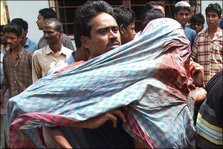
सीपीएम की क्रांति

सीपीएम की क्रांति
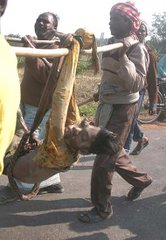
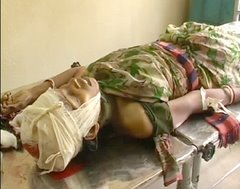
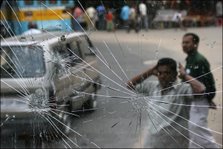
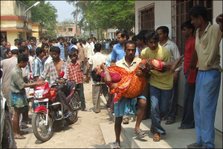
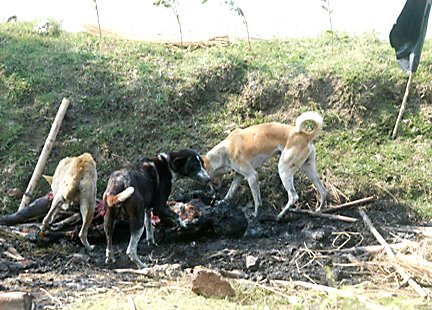
हम एक लोकतंत्र में रह रहे हैं! 14 मार्च को हुई घटना और उसके बाद सीपीएम के बंद के दौरान गायब हुए दो सौ लोगों का अब तक कोई अता-पता नहीं है्. हां। कुछ लाशें हैं जो इलाके में इस हालत में पायी गयी हैं. क्या हम बता सकते हैं कि इन्होंने किस बात की कीमत चुकायी? क्या हम इसको लेकर आश्वस्त रह सकते हं कि हमें भी कभी ऐसी ही कीमत नहीं चुकानी पड़ेगी?
Showing posts with label लेख. Show all posts

Tuesday, April 3, 2007

TRENCH TALES

ENGAGED CIRCLE

Do
Bigha
Zameen
PUSHPRAJ

TRENCH TALES

Farmers are pitted against CPM cadres in West Bengal. A battlelines view

It is my fourth night tracking the Nandigram struggle. I am at a farmer’s home in Gangara, two kms from Bhangabheda. There is no one here apart from Sushma Maiti, the mother of the household — the six other members of her family are in hiding at a relative’s. It is nine at night and we are counting the bombs we hear bursting around us. Interspersed through the shelling are gun reports and shouted slogans: long live the Krishi Zameen Raksha Samiti, long live the farmers’ struggle, hang Buddhadeb Bhattacharya. In this terrifying night of shelling and outcry, we try to hold ourselves together. Don’t be afraid, says Sushma, get some sleep; we’ve heard this for the last two-and-a-half months, tonight you can hear it too.

Naorem Ashish

The Red Brigade in these parts is a goon squad, able to go to any lengths against the farmers
Day breaks late here, upcountry from the Bay of Bengal. By five in the morning, the firing becomes intermittent. The people of 37 villages in the area have come together to protect their lands, due for Special Economic Zone acquisition. Does the Salem Group think it can frighten them with bombs? The ‘revolutionaries’ terrorising the farmers think they are so weak they will run at the first threat. Can 20,000 families leave their homes and fields that easily? The police have been stationed in Khejuri since January 6. But how is one to tell the difference between the CPM’s Red Brigade and the police? What if the State disguises its ‘comrade cadres’ in police uniform?

The Red Brigade in these parts is a goon squad, willing to go to the most shameless lengths to drive farmers off their lands. For two months, 362 households from Khejuri have been living in a camp in Sonachura, run by Krishi Zameen Raksha Samiti (KZRS) volunteers. All have come here with horrific stories of what the goon squads did in their village. It began with their being warned not to associate with the KZRS; non-compliance was met with beatings, extortion and rape. Sixty-five-year-old Nilmani Das says that nothing — land, wealth, one’s daughter — is safe in the village. Schoolteacher Pradeep Pramanik is in hospital after he was mercilessly beaten for supporting the farmers’ struggle. Chinmay Das was attacked at the party office and was forced to cough up Rs 33,000. Vishtu Guriya’s wife was raped; Rs 20,000 was also extorted from him.

Only government-accredited journalists can proceed from Khejuri to the villages of Nandigram. Who is to keep count of the rapes in Sonachura, Gojulnagar, Gangara, Saudkhali and Khejuri? Nor do people here favour complaint when there is so little hope of redressal. “Give me a guarantee that the rapists will be punished,” says a Sonachura farmer, “and then, yes, I will tell you there have been rapes at my home.” The mothers of Sonachura say that if, under the Buddhadeb Bhattacharya government that let off Tapasi Malik’s rapists, there could be no justice in Singur, then they cannot expect any in Nandigram either.

Pushpraj is a freelance journalist

courtesy : Tehelka

Friday, March 30, 2007

Challenging the current development paradigm - A Discussion Paper from Mazdoor Mukti

Challenging the current development paradigm - A Discussion Paper from Mazdoor Mukti

March 29, 2007

Issued for discussion and dialogue by Mazdoor Mukti

Know at the outset that the “we” on whose behalf this proposal is being submitted refers to ordinary people, ordinary labourers, employees, students, youth; who are born with no form of connection with any Establishment, who toil and perish; who at most cast votes during elections, apparently to chose our rulers, but are not involved at any stage of national planning; who are not ministers, nor bureaucrats, nor police chiefs, nor leaders of parties engaged in parliamentary politics; not even promoters-contractors-order suppliers who mill around ministers and bureaucrats; not eminent citizens who wine and dine with capitalists as part of the same elite, bonded socially, culturally and economically in multifarious ways. Simply put, we are those who have no say in how present day society runs or will run. And nor are we among those who are drugged on the belief that capitalism is indeed the last word, and so have pledged to take responsibility for finding solutions to all problems within its given framework. There is another way in which this proposal can be viewed: it is the only rational stand of all exploited-oppressed-persecuted people fighting consistently against the onslaught of capitalism.

All sensitive and conscientious people in West Bengal unanimously condemn the exceedingly undemocratic, inhuman and anti-people process by which thousands of acres of land is being acquired for industry, evicting lakhs of farmers and labourers from their homesteads and livelihoods. But when the Left Front points an accusing finger at these protesters, calling them anti-development, anti-industry and therefore obstructing progress with deliberate intent so that the state remains backward forever – differences of opinion arise within the dissenting camp regarding the response to these accusations. Such differences are but natural since their politics and ideology are not identical. Be that as it may, let us clarify our own stand on this issue.

They say that acquisition of this land is an urgent necessity for industrialisation. Rubbish. Industrialisation does not mean opening one factory. Industrialisation means factory after factory, a barrage of enterprise. That this is not possible at this critical juncture of crisis-ridden capitalism has been admitted by the proponents of industrialization themselves. A natural question that arises of course is: If industrialization is truly on their agenda, why are thousands of factories still closed? Why is no effort being taken to revive them? That we have to accept the dislocation of thousands of lives for the sake of this so-called industrialization, is exactly the kind of argument we find totally unacceptable.

Because, very simply, industrialization or development, whatever they choose to call it, it’s all inspired by capitalism really, all for the benefit of capitalists, and nothing else. Even the roadways and infrastructure they build, the schools, colleges and hospitals, are all for the benefit of capitalists. To ensure a regular supply of various types of employees and workers, and thus keep their chariot-wheels well-oiled. The greatest example of this is the British colonial enterprise in pre-independence India when many such development projects flourished. Even their biggest supporters cannot claim that such projects were implemented for the benefit of the subject people. Now the problem is that continuous unplanned urbanization and indiscriminate proliferation of industry has brought the country to such a pass that any large development plans necessarily entail displacement and deprivation of livelihood of lakhs of people, and massive environmental degradation.

Having created such an impasse, they are now proposing that we should be ready to make sacrifices for the sake of industrialization and progress! We reject such a proposal with disdain. Whenever the rulers are faced with irresolvable problems which they themselves have created, they shift the onus of finding a solution on the suffering masses. And some among us fall into this trap and come forward with constructive plans. Some even glorify such a stance as ‘participatory democracy’. Let us give a few examples to illustrate this.

Example 1:

When the streets of Kolkata were being cleared of hawkers, citizens were asked whether they wished to walk freely and safely, or would they rather allow the hawkers to remain on the footpaths and obstruct free movement? Well firstly, the hawkers have come there through no fault of their own, nor any fault of ours. It is the direct fall-out of the development and industrialization model adopted by the rulers that has increased unemployment and lay-offs.
Thousands of people chose street hawking as a means of livelihood; and the government being unable to provide jobs, had accepted it perforce. Now, after 30-40 years, it seemed to have discovered that the footpaths had to be cleared for the convenience of citizens, so an attempt was made to turn the citizens against the hawkers. As if the hawkers were not citizens too. In any case, when we are asked what other option the government had other than evicting the hawkers, we have to answer that we want both. We wish to walk freely and safely, and we want the livelihood of hawkers to be safeguarded too. Those who have created this dilemma must find a solution themselves.

Example 2:

In the most recent cases of eviction from land, the argument they have put forward is that factories cannot be built on air, therefore, for the sake of industrial development, there is no other alternative to land acquisition. This time, the options are being placed before us thus: If you are in favour of development, you must condone the eviction of farmers and agricultural labourers from their established source of livelihood. If you oppose this, then you are against progress, you are enemies of the people. Wonderful! And remarkably, when some who are opposed to eviction try to put forward constructive advice, their proposed solutions turn out to be equally problematic. For instance, take only single crop land not multicrop land, they suggest. Who gave them the right to issue such an open license to the government we wonder? Did they not consider the fact that the land is not their very own private property? That thousands of people would be dispossessed and deprived there also? Besides, why is such agricultural land not being upgraded to give better yields? Moreover, in Singur you might say don’t take this piece of land, take this other. But when it comes to Nandigram or elsewhere, will you be able to point out 30-40 thousand acres of any alternative site? As responsible citizens, are you willing to mark out any alternative site for such a devastating project as a nuclear power plant in Haripur? If we study development paths being followed in different countries around the world (accepting industrial growth as a subset of development) we can see that development has many faces:

Development that takes place as a matter of day to day routine, which has no negative impact, which in fact we reap side-benefits of, as ordinary people. We don’t worry our heads about such things. We don’t oppose them, nor do we make a big song and dance over them. Things such as road construction, new bus routes or increase in the number of buses, new schools-colleges-hospitals, even new factories fall under this category.

Development by virtue of which large sections of people are displaced and/or deprived of their livelihood. For example the urban slum clearance drive that has been going on for some years, and the virtual requisitioning of farmland which has started recently, throwing village after village in dire distress.

Development that people fight for and achieve. Somewhere a hospital, somewhere a school, or roadways and so on. May be such things did not receive priority in government’s plans or, have been neglected, or have not been in keeping with the immediate needs of capital. We will mark these as our bold rejoinder to capitalism’s onward march. If we do fight and win these little victories, it does not mean that we overcome the limits of capital; but such attacks hinder capitalism’s innate pace and rhythm of growth. (And are therefore a part of the struggle against capitalism.)

On the issue of development and industrialization, our position is clear: When all the resources and wealth come into the collective hands of common people, when the source of inspiration for any development is the human being, then and only then shall we put forward our constructive proposals for industrialization and other such things. At present, you capitalists and your lackeys control politics and the economy; you decide what is to be produced and in what quantities; you budget expenditure on police-army-weaponry; on healthcare, on education, you determine all of this. Under this perspective, when you decide that one or more capitalists wish to build factories, so we must be forcibly displaced from our homes and deprived of our sources of livelihood, such silly and specious arguments we just cannot accept.

We make a humble submission or bold challenge on the issue of industrialization-and-development,. You say that it is for everyone’s benefit that you have made these elaborate plans. Well draw us a road map for the first five years. Show us how this development will benefit every level of society. What percentage of the unemployed will get jobs, what percentage of the hungry millions will get enough to eat, what percentage of the homeless will get a roof over their heads; how many of those who barely survive on the margin of existence, will improve their conditions of living; how many of those presently employed will be assured job security; what percentage will get pure drinking water, what rate of decline will there be in untimely deaths of pregnant women, in infant mortality; what percentage of children will have a chance for schooling, what decline will there be in the percentage of school drop-outs. Etcetera, etcetera.

Along with this, draw a map for 10-15 years, so that we can see clearly how the fruits of development are leading to a more equitable distribution of wealth. Only after we receive such maps, and can witness their effects, shall we think about how genuinely people-oriented your plans really are. Otherwise we take it that your development path will make the rich even richer, leave the poor exactly where they are, waiting like thirsty swallows in indefinite expectation of a few meagre drops from up above. Sorry, we cannot accept such anti-poor, pro-rich programmes as Development.

10 March, 2007
Issued for discussion and dialogue by
Mazdoor Mukti
Contact: Gautam Sen, P-494A Keyatala Road, Kolkata
700029Z Phone: 2465 2507
sengautam@hotmail.com

Development as Poison - Rethinking the Western Model of Modernity

Development as Poison - Rethinking the Western Model of Modernity

By Stephen A. Marglin, Walter S. Barker Professor of Economics at Harvard University.

At the beginning of Annie Hall, Woody Allen tells a story about two women returning from a vacation in New York’s Catskill Mountains. They meet a friend and immediately start complaining: “The food was terrible,” the first woman says, “I think they were trying to poison us.” The second adds, “Yes, and the portions were so small.” That is my take on development: the portions are small, and they are poisonous. This is not to make light of the very real gains that have come with development. In the past three decades, infant and child mortality have fallen by 66 percent in Indonesia and Peru, by 75 percent in Iran and Turkey, and by 80 percent in Arab oil-producing states. In most parts of the world, children not only have a greater probability of surviving into adulthood, they also have more to eat than their parents did—not to mention better access to schools and doctors and a prospect of work lives of considerably less drudgery.

Nonetheless, for those most in need, the portions are indeed small. Malnutrition and hunger persist alongside the tremendous riches that have come with development and globalization. In South Asia almost a quarter of the population is undernourished and in sub-Saharan Africa, more than a third. The outrage of anti-globalization protestors in Seattle, Genoa, Washington, and Prague was directed against the meagerness of the portions, and rightly so.

But more disturbing than the meagerness of development’s portions is its deadliness. Whereas other critics highlight the distributional issues that compromise development, my emphasis is rather on the terms of the project itself, which involve the destruction of indigenous cultures and communities. This result is more than a side-effect of development; it is central to the underlying values and assumptions of the entire Western development enterprise.

The White Man’s Burden

Along with the technologies of production, healthcare, and education, development has spread the culture of the modern West all over the world, and thereby undermined other ways of seeing, understanding, and being. By culture I mean something more than artistic sensibility or intellectual refinement. “Culture” is used here the way anthropologists understand the term, to mean the totality of patterns of behavior and belief that characterize a specific society. Outside the modern West, culture is sustained through community, the set of connections that bind people to one another economically, socially, politically, and spiritually. Traditional communities are not simply about shared spaces, but about shared participation and experience in producing and exchanging goods and services, in governing, entertaining and mourning, and in the physical, moral, and spiritual life of the community. The culture of the modern West, which values the market as the primary organizing principle of life, undermines these traditional communities just as it has undermined community in the West itself over the last 400 years.

The West thinks it does the world a favor by exporting its culture along with the technologies that the non-Western world wants and needs. This is not a recent idea. A century ago, Rudyard Kipling, the poet laureate of British imperialism, captured this sentiment in the phrase “White Man’s burden,” which portrayed imperialism as an altruistic effort to bring the benefits of Western rule to uncivilized peoples. Political imperialism died in the wake of World War II, but cultural imperialism is still alive and well. Neither practitioners nor theorists speak today of the white man’s burden—no development expert of the 21st century hankers after clubs or golf courses that exclude local folk from membership. Expatriate development experts now work with local people, but their collaborators are themselves formed for the most part by Western culture and values and have more in common with the West than they do with their own people. Foreign advisers—along with their local collaborators—are still missionaries, missionaries for progress as the West defines the term. As our forbears saw imperialism, so we see development.

There are in fact two views of development and its relationship to culture, as seen from the vantage point of the modern West. In one, culture is only a thin veneer over a common, universal behavior based on rational calculation and maximization of individual self interest. On this view, which is probably the view of most economists, the Indian subsistence-oriented peasant is no less calculating, no less competitive, than the US commercial farmer.

There is a second approach which, far from minimizing cultural differences, emphasizes them. Cultures, implicitly or explicitly, are ranked along with income and wealth on a linear scale. As the West is richer, Western culture is more progressive, more developed. Indeed, the process of development is seen as the transformation of backward, traditional, cultural practices into modern practice, the practice of the West, the better to facilitate the growth of production and income.

What these two views share is confidence in the cultural superiority of the modern West. The first, in the guise of denying culture, attributes to other cultures Western values and practices. The second, in the guise of affirming culture, posits an inclined plane of history (to use a favorite phrase of the Indian political psychologist Ashis Nandy) along which the rest of the world is, and ought to be, struggling to catch up with us. Both agree on the need for “development.” In the first view, the Other is a miniature adult, and development means the tender nurturing by the market to form the miniature Indian or African into a full-size Westerner. In the second, the Other is a child who needs structural transformation and cultural improvement to become an adult.

Both conceptions of development make sense in the context of individual people precisely because there is an agreed-upon standard of adult behavior against which progress can be measured. Or at least there was until two decades ago when the psychologist Carol Gilligan challenged the conventional wisdom of a single standard of individual development. Gilligan’s book In A Different Voice argued that the prevailing standards of personal development were male standards. According to these standards, personal development was measured by progress from intuitive, inarticulate, cooperative, contextual, and personal modes of behavior toward rational, principled, competitive, universal, and impersonal modes of behavior, that is, from “weak” modes generally regarded as feminine and based on experience to “strong” modes regarded as masculine and based on algorithm.

Drawing from Gilligan’s study, it becomes clear that on an international level, the development of nation-states is seen the same way. What appear to be universally agreed upon guidelines to which developing societies must conform are actually impositions of Western standards through cultural imperialism. Gilligan did for the study of personal development what must be done for economic development: allowing for difference. Just as the development of individuals should be seen as the flowering of that which is special and unique within each of us—a process by which an acorn becomes an oak rather than being obliged to become a maple—so the development of peoples should be conceived as the flowering of what is special and unique within each culture. This is not to argue for a cultural relativism in which all beliefs and practices sanctioned by some culture are equally valid on a moral, aesthetic, or practical plane. But it is to reject the universality claimed by Western beliefs and practices.

Of course, some might ask what the loss of a culture here or there matters if it is the price of material progress, but there are two flaws to this argument. First, cultural destruction is not necessarily a corollary of the technologies that extend life and improve its quality. Western technology can be decoupled from the entailments of Western culture. Second, if I am wrong about this, I would ask, as Jesus does in the account of Saint Mark, “[W]hat shall it profit a man, if he shall gain the whole world, and lose his own soul?” For all the material progress that the West has achieved, it has paid a high price through the weakening to the breaking point of communal ties. We in the West have much to learn, and the cultures that are being destroyed in the name of progress are perhaps the best resource we have for restoring balance to our own lives. The advantage of taking a critical stance with respect to our own culture is that we become more ready to enter into a genuine dialogue with other ways of being and believing.

The Culture of the Modern West

Culture is in the last analysis a set of assumptions, often unconsciously held, about people and how they relate to one another. The assumptions of modern Western culture can be described under five headings: individualism, self interest, the privileging of “rationality,” unlimited wants, and the rise of the moral and legal claims of the nation-state on the individual.

Individualism is the notion that society can and should be understood as a collection of autonomous individuals, that groups—with the exception of the nation-state—have no normative significance as groups; that all behavior, policy, and even ethical judgment should be reduced to their effects on individuals. All individuals play the game of life on equal terms, even if they start with different amounts of physical strength, intellectual capacity, or capital assets. The playing field is level even if the players are not equal. These individuals are taken as given in many important ways rather than as works in progress. For example, preferences are accepted as given and cover everything from views about the relative merits of different flavors of ice cream to views about the relative merits of prostitution, casual sex, sex among friends, and sex within committed relationships. In an excess of democratic zeal, the children of the 20th century have extended the notion of radical subjectivism to the whole domain of preferences: one set of “preferences” is as good as another.

Self-interest is the idea that individuals make choices to further their own benefit. There is no room here for duty, right, or obligation, and that is a good thing, too. Adam Smith’s best remembered contribution to economics, for better or worse, is the idea of a harmony that emerges from the pursuit of self-interest. It should be noted that while individualism is a prior condition for self-interest—there is no place for self-interest without the self—the converse does not hold. Individualism does not necessarily imply self-interest.

The third assumption is that one kind of knowledge is superior to others. The modern West privileges the algorithmic over the experiential, elevating knowledge that can be logically deduced from what are regarded as self-evident first principles over what is learned from intuition and authority, from touch and feel. In the stronger form of this ideology, the algorithmic is not only privileged but recognized as the sole legitimate form of knowledge. Other knowledge is mere belief, becoming legitimate only when verified by algorithmic methods.

Fourth is unlimited wants. It is human nature that we always want more than we have and that there is, consequently, never enough. The possibilities of abundance are always one step beyond our reach. Despite the enormous growth in production and consumption, we are as much in thrall to the economy as our parents, grandparents, and great-grandparents. Most US families find one income inadequate for their needs, not only at the bottom of the distribution—where falling real wages have eroded the standard of living over the past 25 years—but also in the middle and upper ranges of the distribution. Economics, which encapsulates in stark form the assumptions of the modern West, is frequently defined as the study of the allocation of limited resources among unlimited wants.

Finally, the assumption of modern Western culture is that the nation-state is the pre-eminent social grouping and moral authority. Worn out by fratricidal wars of religion, early modern Europe moved firmly in the direction of making one’s relationship to God a private matter—a taste or preference among many. Language, shared commitments, and a defined territory would, it was hoped, be a less divisive basis for social identity than religion had proven to be.

An Economical Society

Each of these dimensions of modern Western culture is in tension with its opposite. Organic or holistic conceptions of society exist side by side with individualism. Altruism and fairness are opposed to self interest. Experiential knowledge exists, whether we recognize it or not, alongside algorithmic knowledge. Measuring who we are by what we have has been continually resisted by the small voice within that calls us to be our better selves. The modern nation-state claims, but does not receive, unconditional loyalty.

So the sway of modern Western culture is partial and incomplete even within the geographical boundaries of the West. And a good thing too, since no society organized on the principles outlined above could last five minutes, much less the 400 years that modernity has been in the ascendant. But make no mistake—modernity is the dominant culture in the West and increasingly so throughout the world. One has only to examine the assumptions that underlie contemporary economic thought—both stated and unstated—to confirm this assessment. Economics is simply the formalization of the assumptions of modern Western culture. That both teachers and students of economics accept these assumptions uncritically speaks volumes about the extent to which they hold sway.

It is not surprising then that a culture characterized in this way is a culture in which the market is the organizing principle of social life. Note my choice of words, “the market” and “social life,” not markets and economic life. Markets have been with us since time out of mind, but the market, the idea of markets as a system for organizing production and exchange, is a distinctly modern invention, which grew in tandem with the cultural assumption of the self-interested, algorithmic individual who pursues wants without limit, an individual who owes allegiance only to the nation-state.

There is no sense in trying to resolve the chicken-egg problem of which came first. Suffice it to say that we can hardly have the market without the assumptions that justify a market system—and the market system can function acceptably only when the assumptions of the modern West are widely shared. Conversely, once these assumptions are prevalent, markets appear to be a “natural” way to organize life.

Markets and Communities

If people and society were as the culture of the modern West assumes, then market and community would occupy separate ideological spaces, and would co-exist or not as people chose. However, contrary to the assumptions of individualism, the individual does not encounter society as a fully formed human being. We are constantly being shaped by our experiences, and in a society organized in terms of markets, we are formed by our experiences in the market. Markets organize not only the production and distribution of things; they also organize the production of people.

The rise of the market system is thus bound up with the loss of community. Economists do not deny this, but rather put a market friendly spin on the destruction of community: impersonal markets accomplish more efficiently what the connections of social solidarity, reciprocity, and other redistributive institutions do in the absence of markets. Take fire insurance, for example. I pay a premium of, say, US$200 per year, and if my barn burns down, the insurance company pays me US$60,000 to rebuild it. A simple market transaction replaces the more cumbersome method of gathering my neighbors for a barn-raising, as rural US communities used to do. For the economist, it is a virtue that the more efficient institution drives out the less efficient. In terms of building barns with a minimal expenditure of resources, insurance may indeed be more efficient than gathering the community each time somebody’s barn burns down. But in terms of maintaining the community, insurance is woefully lacking. Barn-raisings foster mutual interdependence: I rely on my neighbors economically—as well as in other ways—and they rely on me. Markets substitute impersonal relationships mediated by goods and services for the personal relationships of reciprocity and the like.

Why does community suffer if it is not reinforced by mutual economic dependence? Does not the relaxation of economic ties rather free up energy for other ways of connecting, as the English economist Dennis Robertson once suggested early in the 20th century? In a reflective mood toward the end of his life, Sir Dennis asked, “What does the economist economize?” His answer: “[T]hat scarce resource Love, which we know, just as well as anybody else, to be the most precious thing in the world.” By using the impersonal relationships of markets to do the work of fulfilling our material needs, we economize on our higher faculties of affection, our capacity for reciprocity and personal obligation—love, in Robertsonian shorthand—which can then be devoted to higher ends.

In the end, his protests to the contrary notwithstanding, Sir Dennis knew more about banking than about love. Robertson made the mistake of thinking that love, like a loaf of bread, gets used up as it is used. Not all goods are “private” goods like bread. There are also “public” or “collective” goods which are not consumed when used by one person. A lighthouse is the canonical example: my use of the light does not diminish its availability to you. Love is a hyper public good: it actually increases by being used and indeed may shrink to nothing if left unused for any length of time.

If love is not scarce in the way that bread is, it is not sensible to design social institutions to economize on it. On the contrary, it makes sense to design social institutions to draw out and develop the community’s stock of love. It is only when we focus on barns rather than on the people raising barns that insurance appears to be a more effective way of coping with disaster than is a community-wide barn-raising. The Amish, who are descendants of 18th century immigrants to the United States, are perhaps unique in the United States for their attention to fostering community; they forbid insurance precisely because they understand that the market relationship between an individual and the insurance company undermines the mutual dependence of the individuals that forms the basis of the community. For the Amish, barn-raisings are not exercises in nostalgia, but the cement which holds the community together.

Indeed, community cannot be viewed as just another good subject to the dynamics of market supply and demand that people can choose or not as they please, according to the same market test that applies to brands of soda or flavors of ice cream. Rather, the maintenance of community must be a collective responsibility for two reasons. The first is the so-called “free rider” problem. To return to the insurance example, my decision to purchase fire insurance rather than participate in the give and take of barn raising with my neighbors has the side effect—the “externality” in economics jargon—of lessening my involvement with the community. If I am the only one to act this way, this effect may be small with no harm done. But when all of us opt for insurance and leave caring for the community to others, there will be no others to care, and the community will disintegrate. In the case of insurance, I buy insurance because it is more convenient, and—acting in isolation—I can reasonably say to myself that my action hardly undermines the community. But when we all do so, the cement of mutual obligation is weakened to the point that it no longer supports the community.

The free rider problem is well understood by economists, and the assumption that such problems are absent is part of the standard fine print in the warranty that economists provide for the market. A second, deeper, problem cannot so easily be translated into the language of economics. The market creates more subtle externalities that include effects on beliefs, values, and behaviors—a class of externalities which are ignored in the standard framework of economics in which individual “preferences” are assumed to be unchanging. An Amishman’s decision to insure his barn undermines the mutual dependence of the Amish not only by making him less dependent on the community, but also by subverting the beliefs that sustain this dependence. For once interdependence is undermined, the community is no longer valued; the process of undermining interdependence is self-validating.

Thus, the existence of such externalities means that community survival cannot be left to the spontaneous initiatives of its members acting in accord with the individual maximizing model. Furthermore, this problem is magnified when the externalities involve feedback from actions to values, beliefs, and then to behavior. If a community is to survive, it must structure the interactions of its members to strengthen ways of being and knowing which support community. It will have to constrain the market when the market undermines community.

A Different Development

There are two lessons here. The first is that there should be mechanisms for local communities to decide, as the Amish routinely do, which innovations in organization and technology are compatible with the core values the community wishes to preserve. This does not mean the blind preservation of whatever has been sanctioned by time and the existing distribution of power. Nor does it mean an idyllic, conflict-free path to the future. But recognizing the value as well as the fragility of community would be a giant step forward in giving people a real opportunity to make their portions less meager and avoiding the poison.

The second lesson is for practitioners and theorists of development. What many Westerners see simply as liberating people from superstition, ignorance, and the oppression of tradition, is fostering values, behaviors, and beliefs that are highly problematic for our own culture. Only arrogance and a supreme failure of the imagination cause us to see them as universal rather than as the product of a particular history. Again, this is not to argue that “anything goes.” It is instead a call for sensitivity, for entering into a dialogue that involves listening instead of dictating—not so that we can better implement our own agenda, but so that we can genuinely learn that which modernity has made us forget.

Source : Harvard International Review

A Million Nandigrams

A Million Nandigrams

By Sunita Narain

We were standing between a massive mine and a stunning water reservoir. Local activists were explaining to me how this iron ore mine was located in the catchment of the Salaulim water reservoir, the only water source for south Goa.

Suddenly, as I clicked with my camera, we were surrounded by a jeepload of men. They said they were from the mine management and wanted us off the property. We explained that we had come on a public path and that there were no signs to indicate that we were trespassing. But they were not in a mood to listen. They snatched the keys of our jeep, picked up stones to hit us and got abusive. Before things got totally out of hand, we decided to leave.

I was completely baffled at these developments. After all, this was Goa, known for its peace and calm. This was also the place where industrialists–the Dempos, the Salgoacars, the Timblos with mineral interests–play key roles in education, in culture and in promoting the ethics of good corporate governance.

Why would they allow mining to take place next to what is clearly the most important water source for the state? Why were there no signboards with names of owners, near or around the mine? Why would state regulators allow this to happen? What was happening in this paradise to unleash this violence and simmering tension? I got my answers soon.

In the next village, Colomba, I was surrounded once again: Not by goons of a mining company, but by women of the village. We were standing on top of the hill, overlooking the village nestled between coconut and cashewnut trees. But where we were, the bulldozers, mechanised shovels and trucks were hard at work.

They were breaking the hill, shovelling its mud, dumping the rejects and then taking away the ore. The mine had just started operations, said the agitated women, but their streams were already drying up.

Understandably the villagers had just one demand: Close down the mines. I asked how permission had been given without their consent. Who were these companies and whose land were they mining? It was assumed that conditional environmental clearance had been taken to operate the mine located mostly on comunidade land–originally under local community control and only to be leased out for agriculture.

But as the concessions had been granted by the Portuguese government and later converted into leases by the Indian government, these restrictions did not seem to apply. Or, at least, did not matter.

In the next village, Quinamol, the scene was more or less the same. The miners were rowdy; the villagers angry. The only difference was that the mine was older–first mined for manganese and now being excavated for iron ore. The people told me that they had complained but nobody was listening.

I learnt later–the day after my visit–that villagers had stopped a truck loading the material and beaten the driver. A case has now been registered against them. But is it only their fault?

This was the scene in all the villages we passed. What made the situation poignant, and ironical, was the fact that these villages are prosperous areas, where agricultural productivity is the basis of economic wealth. It is this well-being that is being destroyed, bit by bit. I understood then what the demand of ore from China, which had raised prices of the mineral to a new high, was doing to patterns of local economies.

It was in Vichundrem village, however, that I saw the future. Here our vehicle could not proceed up to the hill. It was blocked by a massive boulder. This was the simple but effective blockade by the village. It was their way to keep the miners out of the government forest land that surrounded their fields and provided it spring water for irrigation. The fields were gleaming green in the sun.

I had just seen a million Nandigram mutinies in the making. Where are we headed, I wonder?

Monday, March 26, 2007

Team Up! Follow The Money! India shines!

Team Up! Follow The Money! India Shines!


Palash Biswas


Indian Caste system based Hindutva dominated society is nothing but a model of Graded Inequality which falls in line with Globalisation.
Hence I emphasise Globalisation is itself the Post modern Manusmriti. The leading forces of fascist, Nazi corporate imperialist worldwide aggression and dehumanisation of Mankind are Hindu Brahmins and the Jews controlling US as well as world economy!

Hate the other caste and culture because you happen to be superior by birth, happens to be the base of the rotten Brahminical system in this sub continent. The hate campaign international is best expressed in War On Terrorism ( Against Muslims world wide). The Economic war, which is referred as Globalisation and Market economy is targeted against Blacks and dalits, Underclasses and Refugees, Migrants and Tribals, Minorities and all the Rural People in the third world!

Without an International dalit movement we may not be able to address the Menace globalisation!
They have teamed up!
They follow Money!
India shines for them!

The urgent need for integration in the world economic system for economic growth and development has been identified!
How the Communists in India have changed the Ideology to address globalisation, the models are Nandigram and singur!

Hindu Zionist State power does not understand that Sustained peace and stability can not be guaranteed when the disparity between the rich and the poor, in a nutshell-the haves and have-nots, does not only prevail but also widens!

And this is India Shining!As a country, we have seen the most unprecedented transformation of the economy, ranging from macro-economic stabilisation to the industrial, labour, fiscal and monetary policy reforms. For whom?

How do we address the post modern Manusmriti, Globalisation?

It is essential to understand the nature of conflict in order to address them. ... The globalisation is as fast as the conflicts intensify.
They proclaim globalisation as the total solution to the world problems!


We search of increased foreign direct investment , new markets for export, and development assistance for infrastructural and human resources development has been undertaken. To achieve these objectives we have had to forge alliances with countries and regional blocs, as well establish partnerships with international organisations and trans-national corporations for the purpose of reconstructing and developing the social and economic fabric of our society and the continent in general. Hence the formation of the International Investment Council, International Marketing Council, International IT Council and others, and our close and concerted engagement with among others the IMF, World Bank and WTO.

And thus, we have been enslaved! Wasington happens to be our capital!
The motto is : Follow Money!
Southeast Asia needs to seriously address poverty and economic disorder, corruption, social injustice, basic services and food scarcity.
But the global priorities are Blue films via NET, Mobile Telephony, Auto Boom, Electronics of all kind including computers, cosmetics and consumer junk products, Infrastructure for ruling classes, shopping malls , multiplexes!
Who have to pay for lacs corore Revenue Loss due to Tax holiday for SEZ!

China has made a new production system and streamlined the old production system. this is how they address globalisation!
We evict the Rural India from its Roots, destroy the Natural sources of livelihood for the illiterate, semi literate dalit, tribal underclasses. Devastation of Agro sector has become neo aesthetics!

We have annihilated our Indigenous production system!
This is Globalisation in India and service sector has become the main source of National income, the base of Economic Growth well reflected by sensex!

China does not try English! Chinese may get jobs in Chinese language! We use the language and culture as prostitution.
This is how we address globalisation which is limited in IT sector with mushroomed call centres and pirated soft Ware!

Was Jyoti Basu a Fool who chose not to follow Global Order?

The Writers has been transformed into a Kremlin of Stalin!

Chief Minister Mr Buddhadeb Bhattacharjee today said that though there could be “obstacles” in the path of his government’s industrialisation drive, there would be no going back on it despite the Nandigram incident. “There may be obstacles and complications may arise, but we will go ahead with our industrialisation programme,” Mr Bhattacharjee informed the CPI-M state committee meeting here. Meanwhile, Intellectuals from all walks of life today took out rallies that culminated at Metro Channel near Esplanade to protest against the Nandigram carnage on 14 March.

India Sets Semi Subsidy Policy
Forbes - Mar 22 9:08 PM
Government hopes to attract $6 billion to $9 billion in investments in three years.

Members and followers of Forum of Artists, Cultural activists and Intellectuals, Democratic Students Centre (DSC) a Pro-Naxalite Students took out a procession entitled “Walk for Democracy” from Desh Bandhu Park demanding resignation of chief minister, Mr Buddhadeb Bhattacharjee and a judicial enquiry into the the incidents of Nandigram. The procession converged at Metro Channel opposite Metro Cinema Hall and held a protest meeting there. Eminent personalities associated with the Tollywood film industry like Jossy Joseph, Sashi Anand, Ranjan Palit, Supriyo Sen, Vidyarthi Chattopadhay, Mahadev Shi, Indranil Roy Choudhury among others participated in a rally.
Several artists, directors and producers of documentary folms who voiced their concern today said that they are willing to make documentary films to depict the mass killings at Nandigram. The leaders and supporters of Sagacious Teachers and Employees Association (School), West Bengal Primary Teachers Association and Prathamik Sikshak Kalyan Samity staged a silent sit-in-demonstration at R. R. Avenue to condemn the recent killings at Nandigram.

The "India shining" group may be less than 15% of our population. But they are the rulers. They have the media to shape the "public opinion". As over 80% of Indians are kept as slaves, they hardly have any opposition.

Our legislators are manipulated and made powerless.

We are once again entering into a dark era of zionist-driven Western colonialism. The Brahminical rulers are selling India to White Western rulers. We have been saying this, repeating it. But the killer Bush visit to India finally confirmed it.

Companies team up for project in India

Sunday, March 25, 2007

NEW DELHI
India's Reliance Industries and U.S.-based chemicals producer Rohm & Haas Co. have signed an agreement to explore joint construction of an acrylic acid plant in western India, the two companies said last week.The proposed plant will be located in Jamnagar along India's west coast, where Reliance -- an oil and petrochemical conglomerate -- is building the world's largest oil refinery, a Reliance statement said.

Philadelphia-based Rohm & Haas will provide technology for the plant that will have a capacity to manufacture 200,000 tons of acrylic acid and its derivatives annually, the statement said.

India expects chip policy to attract $5B in foreign investment
Electronics Supply and Manufacturing - Mar 22 9:55 AM
BANGALURU, India — The government said it expects its new chip policy to attract more than $5 billion in manufacturing investments over the next three years.

Irish firm to set up power plant in India
UPI - Mar 23 10:16 AM
India has said McNamara International, an Irish firm, will set up a 2,000 MW power plant in southern Tamil Nadu state. "McNamara International, an ...

Why this sudden Bush love for India?
OUR CORRESPONDENT
Bangalore: When Iran and North Korea are clubbed in the "axis of evil" for making bomb and punished, Iraq was invaded and pounded for "possessing weapons of mass destruction", why George Bush is waiving all norms, rewriting nuclear rules and rushed to India to sell nuclear material?

Why Bush wants India to produce bombs? And against whom? Why he tried to bend all rules for the sake of India? Why this special love?

Will not China now go out of the way to supply nuclear arms to Pakistan?

Is Bush pushing India against China? Why India is surrendering to such dangerous temptations at the cost of the country?

These questions lead us to only one answer: India has played into the hands of American Neo-Cons goaded by the country's over-fed ruling upper castes who, the history says, never had any love for their land.

Foreign investors will ditch India: According to a report the organised sector is contributing about 10% of the Indian economy. The corporate sector is even less. The much-publicised boom in the Indian stock market must not be taken as a reliable indicator of the state of the national economy and of improvement in the economic conditions of the people. The boom is due to Foreign Institutional Investors (FIIs) and the return of the laundered dirty money of Indian capitalists.

An economist warns that (1) an unholy alliance has been forged between the FIIs and Indian capitalists which may prove harmful to India's national interests. (2) Gradually foreign investors have begun exercising control over India's corporate sector. May be one can term this as imperialism through backdoor. (3) The boom hinging on FIIs may not last very long. Once they see greener pastures, they will certainly emigrate, leaving grave consequences for the Indian economy.
http://www.dalitvoice.org/Templates/april2006/reports.htm

William Pesek: Asian billionaires tell tales of their economies
Asbury Park Press - Mar 25 1:36 AM
Follow the money. It's among the first things young reporters learn about covering business. Nowhere is this bit of wisdom more useful than here in Asia. Take Forbes magazine's latest listing of billionaires. It showed a healthy increase in Asians, with the number of Indian and Chinese billionaires nearly doubling. India now has the most billionaires among the top 20, after the U.S.
http://www.app.com/apps/pbcs.dll/article?AID=/20070325/BUSINESS/70324009
A bridge too far
The man squishes through the muddy banks of the Talpati canal on the edge of Nandigram. A rail-thin figure with a thatch of ... Read..
http://www.telegraphindia.com/1070325/asp/7days/index.asp
In wake of West Bengal massacre: Indian workers must advance an independent socialist programme
Sat, 2007-03-24 01:51
By Nanda Wickremasinghe – World Socialist Webs Site

Facing popular opposition across India over the police shooting of scores of peasants in Nandigram last week, West Bengal’s Left Front government, led by the Communist Party of India (Marxist), (CPM), is desperately maneuvering to contain the crisis.

On March 17, the Left Front parties announced that the state government will not expropriate land in Nandigram to set up a Special Economic Zone. They further declared that the massive police presence in the area will be scaled down “in phases,” and that land acquisition for Special Economic Zones in West Bengal will be temporarily suspended.
http://www.asiantribune.com/index.php?q=node/5034

Alliance Semiconductor Closes Sale Of Parcel Of Land Located Outside Of Hyderabad, India For About $3.2 Mln - Quick ...
Nasdaq - Mar 23 3:34 AM
(RTTNews) - Alliance Semiconductor Corp. (ALSC.PK) said that it has completed the sale of a parcel of land located outside of Hyderabad, India for Rs. 140,753,900, or about $3.2 million.

Nandigram part of conspiracy to disturb Left rule, says BimanBose, the Left Front Chairman. Latin American multiple Grammy award singer Shakira arrived in Mumbai Saturday for her first hip-shaking Indian performance.Rice urges Egypt to reform its democracy and India says air-to-air missile tested .Jamiat Ulema-e-Hind is planning to join WB politics. Bangla nationality, betrayed by so called Hindu Muslim national leaders of Undivided India as well as Independent India and pakistan, has the golden opportunity to assert itself as the Next global Super Power India pray for Bermuda to enter in Super Eight round of Cricket carnival on which stakes happen to be billion and billion dollars. With a Bangla win, Global Market forces and Multinational Hindutva Zionist forces would have some spare time for a second Thouht!

How to Exterminate Muslims in India? by Dalit VoiceHow to Exterminate Muslims in India? Dalit Voice, Editorial, May 16-31. 1999 ... Burning of Muslim houses and shops was encouraged to destroy their economy. ...
www.themodernreligion.com/assault/india-ext.html
India Together: Caste - news reports, opinions, analyses, articles ...Ruth Manorama, voice of Dalits Ruth Manorama is a women's rights ... INTERVIEW: NARENDRA JADHAV / ECONOMY/CASTE A Dalit straddles the financial world ...
www.indiatogether.org/society/caste.htm - 26k - Cached - Similar pages

India Together: Caste - news reports, opinions, analyses, articles ...In the recent impressive gains made by the Indian economy, the OBCs have not ... Demand for the randani roti, a staple of Dalit cooking in Central India, ...
www.indiatogether.org/dalit/ - 26k - Cached - Similar pages

EJournals & Newspapers on South AsiaDalit Voice: the voice of the persecuted nationalities denied human rights. ... plus a periodical series of special statistics on the economy and society. ...
www.columbia.edu/cu/lweb/indiv/southasia/ejournals.html - 103k - Cached - Similar pages


India is supplying arms to Burma's military junta to counter China's influence in the neighboring country, but pro-democracy activists fear the junta will use the weapons to suppress opposition and resist democratization!


Opponents of the proposed Special Economic Zone stage a road blockade at Wadkhal in Raigad district of Maharashtra on Friday. Hundreds of farmers took to the streets on Friday opposing the Reliance-promoted Mahamumbai Special Economic Zone (SEZ) and blocked the Mumbai-Goa highway and other roads near Pen in Raigad district in Maharashtra for over three hours. The Government is acquiring land in 45 villages in Pen, Uran and Panvel talukas of Raigad district for the Mahamumbai SEZ promoted by Reliance.

The Shiv Sena and the Peasants and Workers Party (PWP) alliance recently won the majority of seats in the zilla parishad elections in Raigad district. Shouting "Chale Jao (go away) SEZ" slogans the protesters waved the saffron and red and white flags of their parties.

The protest was part of a nationwide action against SEZs on the occasion of Shaheed Bhagat Singh Smriti Diwas. The main demands were that the SEZ Act should be withdrawn, and a national debate should be held on agriculture, land acquisition and development.

While Chief Minister Vilasrao Deshmukh has been saying that land acquisition notices can be withdrawn he has not made any administrative move to do so.

YES, CHIEF MINISTER!

A proposal that Mr Buddhadeb Bhattacharjee must approve if he does not wish to be accused of violating Article 14 of the Constitution.

By RAVINDRA KUMAR

I am planning to write a letter to the Chief Minister of West Bengal. Here is a draft, which I offer to readers ~ who are, after all, the most important stakeholders in The Statesman ~ for comment.

Dear Mr Chief Minister,
I write this on behalf of The Statesman, a newspaper that is more than 130 years old and is directly descended from The Friend of India, founded 1818. In other words, we were born about half a century before the house of Tatas was founded as a trading firm, a reference that you may find mysterious but one that I promise to explain as I go along.
In February last year, we applied to your Housing Minister and head of the West Bengal Housing and Infrastructure Development Corporation for a two-acre plot of land in New Town, Kolkata. In October or thereabouts, some seven or eight months later, we received a letter from WBHIDCO that it had been decided to allot the land to us. But, curiously, there were no details furnished in the letter about the location, the cost or anything else. Thereafter, there has been no word from WBHIDCO.
I had indicated that we required the land for our own use, for production activities and for new business ventures, including software development, that we proposed to set up. While there were several locations available to us for the proposed investment, including in the states of Himachal Pradesh, Uttarakhand, Bihar, Jharkhand and Chhattisgarh, we felt that West Bengal, which has been our home for nearly two centuries, would be most suitable.
http://www.thestatesman.net/page.news.php?clid=3&theme=&usrsess=1&id=150877


In a bid to hone its military might, the Indian Army and Air Force held a day-long military exercise in Bagrakote, West Bengal, on Saturday.Code named "War Fire" the joint exercise in Bagrakote, which falls under the jurisdiction of Jalpaiguri District, involved personnel of the Indian Army's 33 Corps and other Special Forces, and included the use of the latest military hardware.

"A joint exercise involving the infantry, armour, the artillery and the supporting elements and also the air force, the Indian Air Force, which came at the right time as part of the joint operation that was planned," said General Officer C. K. S. Sabu of the 33 Corps.

Modern weaponry, including tanks, helicopters and MiG fighter jets from the 'Hasimara' Air Force base were part of the exercise.


Pakistan will fight war on terror to the end: Musharraf

* President says no one will be allowed political gains from CJP issue

ISLAMABAD: Pakistan and its allies will continue the war on terrorism “till its logical end”, President General Pervez Musharraf told outgoing US Ambassador Ryan C Crocker in a final farewell meeting on Saturday. Aiwan-e-Sadr sources told Online that during talks on terrorism, Gen Musharraf said: “We have to defeat our enemies in this war. However it is essential that the root causes of terrorism are addressed.”

Crocker said Pakistan’s role in the war on terror had been greater than any other country’s, and the world community holds Pakistan in high esteem for this. He said the US takes pride in its strong ties with Pakistan and hoped these would improve further.He said Pakistan attaches a lot of importance to its relations with the US, and Crocker had played a pivotal role in boosting these ties. He said Crocker was instrumental in establishing a strategic partnership between Pakistan and the US and starting the Fulbright scholarship programme for Pakistani students.
Only some like it haute

Is India ready for fine dining? Padmaparna Ghosh finds out
It was the mid-nineties. The United Front government was in power. Michel Camdessus, then managing director of the International Monetary Fund, was visiting New Delhi. P. Chidambaram, then finance minister, hosted a dinner at the Taj Mahal Hotel in N... Read..
http://www.telegraphindia.com/1070325/asp/7days/index.asp

India`s Banks Are Seen as Antiquated and Unproductive
New York Times - Mar 22 4:28 PM
India?s drive to become a global economic powerhouse faces a huge roadblock in its inefficient, largely state-controlled financial system

Comparing India Funds: INP is the Way to Go
SeekingAlpha via Yahoo! Finance - Mar 23 1:09 AM
Garrett Beauvais submits: The fact that The India Fund and Morgan Stanley's India Investment Fund , two closed-end funds focused on India, stopped following the broad Indian market as measured by the India BSE 30 Sensitive Index was painfully clear late last year.

Big Money Allowed To Go Short In India
Forbes - Mar 23 12:23 AM
Institutional investors get permission to short equities in the spot market, a reform that is expected to reduce volatility.

India Expects GE, Alstom to Bid for First Foreign Train Factory
Bloomberg.com - Mar 22 4:02 AM
By Editor: N. Johnson. March 22 (Bloomberg) -- India expects General Electric Co., Bombardier Inc. and Alstom SA to apply to set up factories to build locomotives in the country, the first time foreigners are being invited to do so, a state official said.

UAE premier on trade mission to India
Khaleej Times, United Arab Emirates - 1 hour ago
NEW DELHI - United Arab Emirates Prime Minister Shaikh Mohammed Bin Rashid Al Maktoum was scheduled to arrive in India Sunday on a two-day visit aimed at ...
UAE PM to arrives in India today DailyIndia.com
‘India is a family to us’ Khaleej Times
Mohammed begins India visit today Khaleej Times

Japan recognises India`s quest for nuclear energy
Zee News, India - 2 hours ago
Tokyo, March 25: Japan "recognises" India's quest for civilian nuclear energy cooperation and has promised to "proactively participate" in the discussions ...
India seeks Japan's support for access to nuclear know-how Hindu
India seeks Japan's support, calls NPT 'flawed' Indian Muslims
India wants to take Japan on board for its nuke initiative Economic Times

Realty sector welcomes Sebi’s IPO grading norms
Moneycontrol.com - 23 Mar 2007
Sebi has tightened the disclosure norms for real estate IPOs, and these will come into effect immediately. Pujit Aggarwal, MD, Orbit Corporation and Hardeep Dayal, Group CEO of Kotle Patil Developers discuss the implications.
IPO grading’s mandatory Economic Times
Rating agencies gear up for IPO grading Business Standard

India, Cambodia: Heavy traffic, beggars, ever-larger middle class
Tad Stryker (North Platte Bulletin)
About 40 hours after leaving Denver, I entered India at Calcutta, and quickly it became evident that I had left the West far behind.

[Editor’s Note: Bulletin sports editor Tad Stryker is working on a book about evangelicalism in the United States. It’s a case study of the Berean Fellowship. One of the Bereans’ projects is planting churches in India in conjunction with Campus Crusade for Christ.

In January, George Cheek, who is closely involved with the church-planting project, was preparing to make his 14th trip to India and wanted to take someone along, so Stryker jumped aboard. Cheek had to leave for India a week ahead of Stryker, which meant that Stryker had to find him at the airport there. His story:]

Calcutta is a filthy, noisy, congested, chaotic city. As someone who grew up on a Nebraska farm, I had an incessant sensation of claustrophobia while I was there.
Read Full Story:
http://www.northplattebulletin.com/NorthPlatteBulletin/stories/index.asp?pageID=3&storyID=12537

The cat is out of the bag. The world’s most authoritative economic journal, the Economist (Jan.27, 2007), and also sympathetic to Brahminical rulers, has said India’s GDP bragging and boasting is wholesale bluff and bunkum.

Did we not say that the rulers are simply misleading India and deceiving the outside world on the country’s “booming and bursting” GDP?

The article in the “Finance and economics” section of the Economist by its editor in charge says “comparison with China shows India’s boom may be less impressive than it seems”.

Slap on face of India: What a shame on India’s bragging and boasting Brahmins that the world famous journal so favourable to India’s rulers had to give a slap on their face annoyed by their noisy song and dance over the “soaring GDP” of India claiming that it is about to exceed that of China.

The Economist could not tolerate the bundle of lies and finally had to come out with an authoritative article refuting the official claim of the Manmohan Singh Govt.

The Economist says:

India has been swept by optimism that its economy can do as well as China’s. A recent article in the Economic Times claimed that the growth in India’s total factor productivity (TFP), the efficiency with which inputs of both labour and capital are used, had accelerated, whereas China’s had slowed owing to wasteful investment. As a result, the article boasted, rising productivity — the main driver of long-run economic growth — is now running neck and neck in the two economics. Close inspection of the numbers, however, reveals that China remains well ahead.

False hope of moksha: It is well known how the Brahminical people have been ruling us from thousands of years by giving false hopes. Their “sacred scriptures” are themselves a bundle of lies assuring moksha to all those who bribe and surrender to the Brahmin.

The problem with these people is that they never believe in facts, rational thinking, scientific analysis or logical conclusions. The Brahminical Hindu believes what he wants to believe. And this belief system is killing the country.

Spit on their face: Otherwise, where is the need to bluff on vital statistics which are available to all thinking people the world over and better experts than the Brahmins. Can they (experts like the Economist) not check these facts and figures and spit on their face?

The Economist adds:

Both India and China have large population, lo

Why this sudden Bush love for India?
OUR CORRESPONDENT
Bangalore: When Iran and North Korea are clubbed in the "axis of evil" for making bomb and punished, Iraq was invaded and pounded for "possessing weapons of mass destruction", why George Bush is waiving all norms, rewriting nuclear rules and rushed to India to sell nuclear material?

Why Bush wants India to produce bombs? And against whom? Why he tried to bend all rules for the sake of India? Why this special love?

Will not China now go out of the way to supply nuclear arms to Pakistan?

Is Bush pushing India against China? Why India is surrendering to such dangerous temptations at the cost of the country?

These questions lead us to only one answer: India has played into the hands of American Neo-Cons goaded by the country's over-fed ruling upper castes who, the history says, never had any love for their land.

William Pesek: Asian billionaires tell tales of their economies
Asbury Park Press - Mar 25 1:36 AM
Follow the money. It's among the first things young reporters learn about covering business. Nowhere is this bit of wisdom more useful than here in Asia. Take Forbes magazine's latest listing of billionaires. It showed a healthy increase in Asians, with the number of Indian and Chinese billionaires nearly doubling. India now has the most billionaires among the top 20, after the U.S.
http://www.app.com/apps/pbcs.dll/article?AID=/20070325/BUSINESS/70324009
A bridge too far
The man squishes through the muddy banks of the Talpati canal on the edge of Nandigram. A rail-thin figure with a thatch of ... Read..
http://www.telegraphindia.com/1070325/asp/7days/index.asp
In wake of West Bengal massacre: Indian workers must advance an independent socialist programme
Sat, 2007-03-24 01:51
By Nanda Wickremasinghe – World Socialist Webs Site

Facing popular opposition across India over the police shooting of scores of peasants in Nandigram last week, West Bengal’s Left Front government, led by the Communist Party of India (Marxist), (CPM), is desperately maneuvering to contain the crisis.

On March 17, the Left Front parties announced that the state government will not expropriate land in Nandigram to set up a Special Economic Zone. They further declared that the massive police presence in the area will be scaled down “in phases,” and that land acquisition for Special Economic Zones in West Bengal will be temporarily suspended.
http://www.asiantribune.com/index.php?q=node/5034

Alliance Semiconductor Closes Sale Of Parcel Of Land Located Outside Of Hyderabad, India For About $3.2 Mln - Quick ...
Nasdaq - Mar 23 3:34 AM
(RTTNews) - Alliance Semiconductor Corp. (ALSC.PK) said that it has completed the sale of a parcel of land located outside of Hyderabad, India for Rs. 140,753,900, or about $3.2 million.

Nandigram part of conspiracy to disturb Left rule, says BimanBose, the Left Front Chairman. Latin American multiple Grammy award singer Shakira arrived in Mumbai Saturday for her first hip-shaking Indian performance.Rice urges Egypt to reform its democracy and India says air-to-air missile tested .Jamiat Ulema-e-Hind is planning to join WB politics. Bangla nationality, betrayed by so called Hindu Muslim national leaders of Undivided India as well as Independent India and pakistan, has the golden opportunity to assert itself as the Next global Super Power India pray for Bermuda to enter in Super Eight round of Cricket carnival on which stakes happen to be billion and billion dollars. With a Bangla win, Global Market forces and Multinational Hindutva Zionist forces would have some spare time for a second Thouht!

How to Exterminate Muslims in India? by Dalit VoiceHow to Exterminate Muslims in India? Dalit Voice, Editorial, May 16-31. 1999 ... Burning of Muslim houses and shops was encouraged to destroy their economy. ...
www.themodernreligion.com/assault/india-ext.html
India Together: Caste - news reports, opinions, analyses, articles ...Ruth Manorama, voice of Dalits Ruth Manorama is a women's rights ... INTERVIEW: NARENDRA JADHAV / ECONOMY/CASTE A Dalit straddles the financial world ...
www.indiatogether.org/society/caste.htm - 26k - Cached - Similar pages

India Together: Caste - news reports, opinions, analyses, articles ...In the recent impressive gains made by the Indian economy, the OBCs have not ... Demand for the randani roti, a staple of Dalit cooking in Central India, ...
www.indiatogether.org/dalit/ - 26k - Cached - Similar pages

EJournals & Newspapers on South AsiaDalit Voice: the voice of the persecuted nationalities denied human rights. ... plus a periodical series of special statistics on the economy and society. ...
www.columbia.edu/cu/lweb/indiv/southasia/ejournals.html - 103k - Cached - Similar pages


India is supplying arms to Burma's military junta to counter China's influence in the neighboring country, but pro-democracy activists fear the junta will use the weapons to suppress opposition and resist democratization!
Why this sudden Bush love for India?
OUR CORRESPONDENT
Bangalore: When Iran and North Korea are clubbed in the "axis of evil" for making bomb and punished, Iraq was invaded and pounded for "possessing weapons of mass destruction", why George Bush is waiving all norms, rewriting nuclear rules and rushed to India to sell nuclear material?

Why Bush wants India to produce bombs? And against whom? Why he tried to bend all rules for the sake of India? Why this special love?

Will not China now go out of the way to supply nuclear arms to Pakistan?

Is Bush pushing India against China? Why India is surrendering to such dangerous temptations at the cost of the country?

These questions lead us to only one answer: India has played into the hands of American Neo-Cons goaded by the country's over-fed ruling upper castes who, the history says, never had any love for their land.
http://www.dalitvoice.org/Templates/april2006/reports.htm

The Communist Party of India (Marxist) on Friday asserted that the Left Front Government in West Bengal would not give up the industrialisation policy. It, however, emphasised that agriculture would be protected and developed further without any damage to the gains of land reforms.

Responding to criticism from various quarters in the wake of the Nandigram incidents, the party said it was time to reverse long years of de-industrialisation.

``Balanced economic development requires industrialisation within the capitalist framework too. If some argue that small and medium industries are sufficient, the CPI (M) does not agree. Large-scale units, particularly in manufacturing, are necessary,'' party general secretary Prakash Karat said in an article in the latest edition of the party organ, People's Democracy.

Opponents of the proposed Special Economic Zone stage a road blockade at Wadkhal in Raigad district of Maharashtra on Friday. Hundreds of farmers took to the streets on Friday opposing the Reliance-promoted Mahamumbai Special Economic Zone (SEZ) and blocked the Mumbai-Goa highway and other roads near Pen in Raigad district in Maharashtra for over three hours.

The Shiv Sena and the Peasants and Workers Party (PWP) alliance recently won the majority of seats in the zilla parishad elections in Raigad district. Shouting "Chale Jao (go away) SEZ" slogans the protesters waved the saffron and red and white flags of their parties.

Led by veteran PWP leader N.D. Patil, the agitation began at 11 a.m. at Vashi Naka near Pen. The protesters walked three km to Wadkhal Naka on the Mumbai-Goa highway, about 80 km from Mumbai. Traffic was diverted at various places, according to the police, causing huge pile-ups along the way.

(Contact: Palash C Biswas, C/O Mrs Arati Roy, Gosto Kanan, Sodepur, Kolkata -&00110, India. Phone: 91-33-25659551)
Email: palashchandrabiswas@gmail.com
Killing Instinct V/S Inherent Injustice

Killing Instinct V/S Inherent Injustice

Palash Biswas

On the 76th anniversary of the martyrdom of Bhagat Singh 'Revolutionary Democracy' has put up on its newly opened Archival Material section 5 letters of Bhagat Singh which we have received from Comrade Chaman Lal of JNU.
See:
www.revolutionaryde mocracy.org
Long Live the Memory of Comrade Bhagat Singh !
What is reservation and Quota? These constitutional provisions have become best tools for the ruling Classes to accommodate all kinds of Bastards and demoralise the actual worthy and potential Dalit tribal elements!Where happen to be all those quota politicians , the SC, ST MPs and MLAs when a Nandigram is crushed?All SC, ST, BC, OBC so called representatives are picked and sponsered by the Ruling Classes. Hence they pose well as DUMB, DEAF and Blind!This is Polity Indian!Gandhi boasted dalits are integral part of Hindutva. Gandhi denied separate existence of Underclasses in India.Gandhi launched Anti Untenability Front later known as Hrijan sevak sangh to alienate the dalits from tribals, BC and OBC and minorities and from Shudras.Gandhi never recognised dalits as Shudras!Gandhi always saved the interests of Brahmins, Zamindars and Capitalists. He posed as Mahatma as India happens to be a country of small and big Gods and Religion happens to be the ultimate opium! Vaidiki Rituals is the gist of Gandhism.The Brahmin Ideologues and some Shudra followers and In- Laws well known for their sympathy with Sangh Parivar have come out with SEZ weapon to kill Communism in India and Indian Gorbachev oblige!
But the Polity and Economy , Society and Culture, Languages and Nationalities are all about Cricket. Screaming Headlines in Print Media and violent News Breaks on TV screen expose what is Cricket all about all over the sub continent!
It is Post Modern Manusmriti authored by Brahminical Imperialist, Zionist Global Order that the underclasses have to be deprived of their mother languages! Since English is out of their purchasing reach and the IT also, thus the Shudrayan continues well. The Ashwa Medh reborn!
Let all Indian languages whither away. Let all Indians speak English by 2060. Let this happen and India will be a better nation, feels Dalit activist But, that will not make non-English speaking Brahmins fall below the untouchables in Indian society. Dalits have a double disadvantage, that's my point. I think acceptance of the supremacy of English is a grim reality. It's not a wrong thing to do.Even when a passerby on Indian roads overhears someone speaking in English he respects him more than other guys. This recognition will help in nation building.
Let all Indian languages whither away and let all Indians speak English by 2060 or so. Many of the regional problems will disappear. The fights between Kannada and Telugu or Tamil will be solved. India will be a better nation.Something good about your identity, community and culture will also vanish by abandoning your language.
See how CPM cadare and police took part to kill farmers in Nandigram!!. Read KOLKATA 's Anand Bazar Patrika online
http://www.anandaba zar.com/
It is Inherent Injustice fielded against Killing Instinct Of God Indra! It is Ramchandra who failed to kill the Ravan this time as there is no Hanuman or Bibhisan. Hanuman has crossed the fence and bibhisan is in the Indian camp itself.
Party stands by Buddha, gets restive allies to fall in line.Criminal of Marichjhapi stands by the Murderer of Nandigram!
Shambuk has to be killed as no one should dare to violate the Vaidik Aryan dominance.
India may further open markets to LDCs in SAARC and commerce Minister of India Shameless corporate agent Kamalnath speaks out SEZ policy must not be mixed up with land issue even after Kalinganagr and Nandigram massacre. Non Cong Gandhians and Lohiates are out of den with all the traditional venom against Ideology communism! Rotten Gandhiism is in back gear! Was Gandhi a Mahatma at all? did not he force Ambedkar for Poona Pact? Did not he accepted all Muslim League demands bargaining with cast Hindu Brahminical interests to deprive Indian underclasses of their legitimate human and civil rights?
Guru Greg Chappel must be replaced with Railway Minister Laloo Prasad Yada to enrail the derailed Team Inida train captured by Globalisation! Some one should be there to manage and address the open market oriented Indian Cricket. This is the only way to save face of indian Cricket!Just read this article:Lalu, a good manager for MIT studentshttp://www.rediff.com/money/2007/mar/24lalu.htm
What went wrong with Team India?
Indian cricket faces revamp after Cup debacle N.Ananthanarayananhttp://www.rediff.com/wc2007/2007/mar/24india1.htmhttp://www.rediff.com/wc2007/2007/mar/24msg.htm
I'm not going to blame anybody: ChappellN. Ananthanarayananhttp://www.rediff.com/wc2007/2007/mar/24chap.htm
Team India lacks the Killing Instinct ans it should have some element of it from the Ruling Brahmins who intend to demolish Rural India!Team India lags behind Strike Rate but Indian Forces have all the Strike Power to annihilate any protest any resistance from the Dalit, Tribal Minority bases.
Former players, board officials and the national media were united in condemning an Indian team that had all but crashed out of the World Cup in the Caribbean on Friday.Winners in 1983 and finalists in the last tournament, India suffered a 69-run defeat in their crunch Group B match against Sri Lanka and their slim hopes of progressing now hinge on an unlikely defeat for Bangladesh by debutants Bermuda on Sunday.http://www.rediff.com/wc2007/2007/mar/24india.htm
This is not Cricket!http://predict.rediff.com/worldcup.php?gid=10001,103,2 Loss to Sri Lanka turns Indian heat on ChappellSydney Morning Herald - 1 hour agoTesting times ... India coach Greg Chappell is hopeful his team's latest loss to Sri Lanka and their poor tournament form won't spark violence by disappointed fans.Cricket-Coach Chappell's future in focus after World Cup debacle Reuters.ukIndia all but crash out of World Cup Mail & Guardian OnlineGulf News - India eNews.com - Economic Times - Hinduall 628 news articles »
CBC.caWho killed the coach?The Age - 1 hour agoBob Woolmer two weeks ago during cricket practice in Trinidad, and the Jamaica Pegasus Hotel in Kingston, where he was found strangled.Cup continues to honour Bob FOX SPORTSSlaying casts cloud over genteel sport of cricket Houston ChronicleDaily News & Analysis - Hindu - The Saturday Post - Independent Onlineall 3,048 news articles » A Must Read by Karat: What really happened in Nandigram Prakash Karat March 23, 2007
The events in Nandigram, starting from the January 3 incident have been the subject of a heated controversy. A feature of this political tussle has been the concerted attempt to attack the Communist Party of India-Marxist on the grounds that it is taking an anti-peasant stance in favour of big companies. It is accused of using the police for this purpose.
The March 14 incidents when the police entered Nandigram and police firing took place have led to protests in West Bengal and in other parts of the country. At the national level, the Bharatiya Janata Party and its allies have focussed on this incident. Parliament was disrupted for five successive days. The BJP and the Trinamul Congress have demanded the imposition of Article 356 in West Bengal. Some other opposition groups have demanded the removal of Chief Minister Buddhabeb Bhattacharya.
It is essential to understand what happened in Nandigram and what are the issues involved. First of all, it must be clear that the police action in Nandigram was not for any land acquisition. It is true that the West Bengal government had considered certain areas within Nandigram for the proposed chemical hub to be set-up as a Special Economic Zone. This was under the consideration of the state government. There was no notification for land acquisition by the authorities at any stage. There was a notice by the Haldia Development Authority for public information regarding the likely location of the project. It is this notice which set off protests by people in Nandigram Block I.Read More:http://www.rediff.com/news/2007/mar/23karat.htm Read this article also:Nandigram villagers cope with dispossession
Monideepa BanerjieSaturday, March 24, 2007 (Nandigram)It's been more than a week since 14 people died in the clash between Nandigram villagers and the police, and life is not even beginning to limp back to normal.
Instead, what is dawning on the people on both sides of the battleline, the CPM and the Bhoomi Uchched Pratirodh Committee, is that they are all dispossessed.
Almost three months ago, as tension spiralled over rumours of land acquisition for an SEZ, they were driven out of their homes at Sonachura and half a dozen other villages by the Bhoomi Uchched Pratirodh Committee. Read More:http://www.ndtv.com/convergence/ndtv/story.aspx?id=NEWEN20070006803
Dear Friends, Here is a sample petition calling for judicial enquiry in Nandigram violence of March 14, its runup and aftermath.Pls. do mail and/or fax to the addressees on the same/similar lines.A copy may be forwarded to: <sukla.sen@gmail.com>. BestSukla ToThe ChairmanThe National Human Rights Commission,New Delhi<ionhrc@nic.in><covdnhrc@nic.in>Tel.: +91 22 23384012Fax: +91 22 23384863 CC:
I. National Commission for WomenNew Delhi<ncw@nic.in>Fax: +91-11-23236154Complaints Cell: +91-11-23219750 II.National Commission for MinoritiesNew Delhi<ncm-mma@nic.in>Tel.: +91 22 24618349Fax: +91 22 24693302/24642645/24698410 III.National Commission for Scheduled CastesNew Delhi<chairman-ncsc@nic.in>Fax: +91 22 24601213<jointsecretary-ncsc@nic.in>Fax: +91 22 24625378/24634743/24615014 Sub: Violence and repression in Nandigram in West Bengal causing large-scale loss of lives and displacement Sir, You must be aware of the fact that on the March 14 last a large posse of police force under the command of the West Bengal government had entered the Nandigram area in the East Midnapore district of West Bengal ostensibly to establish the "rule of law". You may also recall that since early January the area is in turmoil.To be more precise, on January 2nd, the Haldia Development Authority (HAD) had issued a preliminary notice indicating a plan to acquire about 14,500 acres of land of 27 moujas ofNandigram-1 block and 2 moujas of Khejuri-2 block. It had also been announced that the land of Nandigram block would be acquired shortly since the Salim Group would build a mega Chemical Hub (10,000 acres) and another industrialist group of Pawan Ruia would set up a Shipbuilding and repairing unit (2500 acres) there. The rest of the land (2000 acres) would be used for disposal of alluvium dredged from the river bed of Haldia Port. The list of earmarked moujas was sent to the concerned Gram Panchayats. The notice mentioned the names of total 29 moujas at the Nandigram-1 and Khejuri-2 blocks that had primarily been shortlisted for the Salim-promoted chemical hub which included 5 Gram Panchayats in Nandigram -1 block namely 10 No. Sonachura, 9 No. Kalicharanpur, 3 No. Kendemari, 2 No. Muhammadpur and 1 No. Vekutia and Khejuri GP in Khejuri-2 Block.This notice, to use a rather cliched expression, set a cat among the pigeons. There was large scale disquiet amongst the local people.It set off a series of violent clashes since January 3 between the villagers and the State administration and also between sections of villagers. This culminated in bloody and murderous violence on January 7 between villagers determined not to part with their lands and the followers of the CPIM supporting the threatened move of the State government. While there are conflicting reports about the violence, the fact that human lives were lost is irrefutable. The active and personal involvement of Shri Lakshman Seth, the CPIM MP from Haldia, who is also the Chairman of the HDA, was also widely alleged.
Be that as it may, as a consequence the State government issued a clarification subsequently that the said notice had been wrongly issued without proper authority and land acquisition for the chemical hub would be put on hold for the time being.But, as it appears the State government and its leaders enjoyed little credibility amongst the villagers. It’d be pertinent to recall that in the wake of the January 7 violence allegedly between the armed supporters of the CPIM coming from either outside or from the temporary camps, where they had shifted to and taken shelter since January 3 consequent upon earlier clashes, surrounding the area; a senior Polit Bureau member of the CPIM and also a Rajya Sabha MP from west Bengal categorically denied the very existence of the HAD notification and branded such report as mischievous rumour mongering. It is, however, quite another matter that the Chief Minster, belonging to his party, had to admit otherwise. Consequently the villagers cut all the roads connecting to the outside world off keeping provisions for only temporary and removable bridges in anticipation of large scale invasions from outside. All attempts by the State administration to convince the villagers of its pious intentions failed to cut any ice with them. It would also be pertinent to mention here that Nandigram is just not an isolated stand-alone case. A running battle between the State and the CPIM on the one hand and (at least some) villagers in Singur in neighbouring Hooghly district where land to the tune of a thousand acres has been acquired by the State, with active collaboration of the party apparatus, on behalf of the Tata Motors is very much on. There are also similar other proposals in the pipeline. All these taken together perhaps explain the complete lack of faith of the villagers in any assurance of the State government. On march 14, a police campaign of huge proportions was carried out to occupy and re-take Nandigram. The official figure of casualties hovers around 15. Other sources estimate over hundred. Given the demographic pattern, most of the victims are understandably either Dalits or Muslims.There are also widespread allegations that the police in collaboration have dumped a large number of dead bodies in water bodies with the CPIM cadres. There are also allegations of gang rapes and beastly sexual assaults.TV footages reportedly exist showing bodies being fished out of water apart from some police actions though entry of the journalists had reportedly been by and large blocked during the campaign and also thereafter till the Honourable High Court intervened.That such an operation is going to be carried out had already been predicted by a section of the media.It has also been reported that an intelligence report apprehending broad-based vigorous resistance and consequent large-scale bloodshed was deliberately ignored. There also reports that maximum violence has been resorted to in preference over other routine alternatives.Under the circumstances, even the Honourable Calcutta High Court had to adversely comment on the ferocious operations carried out by the State against its own people and has ordered a CBI probe.
While the CBI probe has played and would play a useful role in crying an immediate halt to any large-scale ongoing violence against the local people, it is simply inadequate given the seriousness of the situation. We would therefore earnestly request you to immediately send a team of your own to make an on-the-spot survey and also take up the issue with appropriate quarters, not excluding the Supreme Court of India, to immediately institute a judicial enquiry conducted by a serving judge or judges, nominated either by the Chief Justice of the India or the High Court of Kolkata. Any enquiry by a retired judge nominated by the State government, if at all, would largely defeat the purpose for very obvious reasons.You are also urged to ensure that the culprits – the perpetrators of violence, are brought to book in the shortest possible time, and the affected people are provided immediate relief and also reparation. Not only those directly engaged, the planners and conspirators must be identified and be made pay for their sins.This is the most minimum that has got to be done so that the common people keep faith in the system and are not encouraged to take law in their own hands in their own desperate, and maybe mindless, ways. Sincerely yoursSukla SenEKTA (Committee for Communal Amity)Mumbai
Dear Friends:
The US India Institute of Washington, DC is sponsoring a symposium on
US India Strategic Relations
at
Yale UniversityThe Whitney and Betty MacMillan Center forInternational and Area Studies at YaleNew Haven, CT
on Friday, April 13, 2007.If you would like to attend the symposium, please contact Professor Phyllis Granoff at phyllis.granoff@ yale.edu (with a copy to Armeane Choksi at amchoksi@usini. org) letting her know of your interest in attending.
Cheers,
Ram NarayananUS-India Friendshiphttp://www.usindiaf riendship. net/
What is my identity? What is worth preserving in us? See, after we unveiled the goddess of English, critics said that the English-speaking Dalits will get distanced from the traditional knowledge system. I want to say clearly that the entire fight of the Dalit movement is to somehow get rid of the traditional knowledge system and occupation.
Like, the dhobis (washermen) of India have profound and exceptional knowledge of creating detergents from the dung of donkeys. It's a complicated process. Do you think those Dalits enjoy making detergent from dung? I want to tell these people -- who are against us in our endeavour to know English -- let us exchange our knowledge system.
You give us teaching jobs and other decent jobs and you take the knowledge of donkey dung. Without any training, without going to school or colleges or without learning from skilled teachers, Dalits can skin a dead cow in an hour without messing up or cutting various parts of the body. It is (skinning of dead animals) a real art acquired with profound knowledge of the body science of animals.
We want to gift our talent to other castes. You require exceptional level of human patience if you collect human shit in your bare hands and don't vomit. Dalits have been doing it for ages. Please take this knowledge immediately and allow us to go to CSDS (Centre for the Study of Developing Societies)!
Alok Rai, the Hindi legend Premchand's grandson, has also protested against Dalits abandoning ethnic languages. He is a professor of English at Delhi University. He has a dog named Rocky. He talks to his dog only in English. Even his dog understands English and he doesn't want Dalits to know English. What hypocrisy!
Don't you agree that Indian languages have their own beauty and are reflecting Indian ethos and culture? What will happen to it once the whole of India abandons ethnic languages?
Those in India today who are considered advanced are generally those who have distanced themselves from their traditions and culture. They know that Western societies are a cradle of modern civilisation, technology and science. Indians should adopt Western society's idea of equality, modern science and knowledge.
Be aware of Post modern Manusmriti.Be aware of the Brahmins who head political parties and eco-social-cultural entities!Be aware of those Dalit leaders who are habitual to sleep with Caste and Class enemies!Be aware of the Lohiaite and Gandhian Brahmin and Shudra Ideologues who have jumped in war with a sympathetic gesture to the depressed but are trying their best to defend the ancient as well as the Post Modern manusmiriti!Be aware of the betrayal during Struggle of Freedom!Be aware of the Brahminical betrayals during all kinds of Mass Uprising in this sub Continent!
Please read all these articles to assess what Gandhi did for the Ruling Classes?
Dalit Voice - The Voice of the Persecuted Nationalities Denied ...The eminent Dalit intellectual and Editor of Dalit Voice, V.T. Rajshekar ... DV Nov.16, 2004 p.10: "Gandhi & Gandhism — a cruel hoax on oppressed Indians". ...www.dalitvoice.org/Templates/oct_a2005/articles.htm - 46k
Dalit Voice - The Voice of the Persecuted Nationalities Denied ...His name was removed from Dalit Voice from the issue of Jan.16, 1985 as desired. ... The rise of Gandhi and his gandhism took place when the Tilak-sponsored ...www.dalitvoice.org/Templates/oct_a2004/articles.htm - 30k Muslim-Dalit Relations By Gail OmvedtThis cannot be done with an acceptance of Gandhism as the framework for "Hindu-Muslim unity." It can only be done by listening to the Dalit voice, ...www.countercurrents.org/dalit-omvedt220505.htm - 21k
Gandhism: Information from Answers.comIt lives within us, as the voice that tells us what to do, but also guides the universe. ... Gandhi, Gandhism and the Gandhians. Roli Books Pvt. Ltd.. ...www.answers.com/topic/gandhism GandhiServe Foundation - Mahatma Gandhi News DigestHe led its foundation with the help of 200 odd Dalit families of the village. ... Gandhism vs terrorism Even if Gandhi is relevant today, can his ideals be ...www.gandhiserve.org/news/mgnd/news200610011008.html - 79k Beyond The Symbolic AmbedkarUpendra Baxi wrote a short piece titled “Collective conspiracy to hush up Babasaheb’s burning thoughts” in Dalit voice in 1992. ...www.countercurrents.org/dalit-satyanarayana280603.htm - 12k
Alike the Indian Gandhi, post modern puuppets of Imperialism try their best to enhance the World order to crush the underclasses and nationalities worldwide. UN is the best tool of US Imperailism which defends well the Hindutva and Zionist system!
Security Council set to approve new UN sanctions on IranNew Straits Times - 23 minutes agoThe Security Council is set to slap new UN sanctions on Iran Saturday over its nuclear defiance with the Iranian foreign minister due to attend the session to defend his country's right to conduct uranium enrichment.Iran Accuses Britain of Aggression New York TimesIran's president won't address Security Council Boston Globe
India to go ahead with the Iran gas pipeline: DeoraDaily News & Analysis - 4 hours agoPTI. MUMBAI: Unperturbed by concerns raised by the US on the proposed 7.2 billion dollar Iran-Pakistan-India gas pipeline, India today made it clear it will go ahead with the project.India can't be pressured on Iran pipeline project: Deora HinduIndia says won't be pressured on Iran gas pipeline Reuters India
With Afghanistan set to join SAARC as the eighth member, India is likely to announce relaxation of imports from least developed countries of South Asia by cutting duties and reducing negative and sensitive lists at the Summit of the regional grouping next month.The relaxation will also benefit Bangladesh, Nepal Maldives and Bhutan, sources said. The decision to extend increased market access to LDCs in South Asia would soon be taken by the Prime Minister's office in consultations with ministries of external affairs, commerce, agriculture and finance.Since the European Union and the US would be present as observers at the Summit next month, the gesture would send a positive message about India's commitment to reach out to LDCs in its neighbourhood. India is also preparing a similar package for a wider group of LDCs under the WTO.According to sources, it would also bring pressure on Pakistan, which has not opened up its market for India violating SAFTA that came into effect last year.

Under the SAFTA, the three non-LDC members - India, Sri Lanka and Pakistan - are required to bring their duties to less than five per cent in three years. "India could advance this date unilaterally," sources said.While this package would bring goodwill to the country, it would not effect economic interests as India's $7 billion trade with SAARC is a small percentage of its global merchandise trade of over $300 billion.Pakistan's refusal to open up its markets for India under the trade agreement is likely to figure at the SAARC Summit. Unlike other members, Pakistan allows concessional imports from India of only 1,075 items and everything else is closed for exporters here.
A new genetic study of ethnic communities and population groups in India has debunked the theory that the caste system came with the Aryans.Biologist Kumarasamy Thangaraj finds himself treading the turf of historians. A scientist at the Centre for Cellular and Molecular Biology (CCMB) in Hyderabad, Thangaraj has been using genetic material from ethnic and caste communities from across India to piece together the social and migratory history of its people. The findings, as he is discovering for himself, may at times be revelatory and at times provocative enough to stir a debate. Thangaraj’s latest study has bolstered genetic evidence to support an alternative theory for the origins of India’s ancient, controversial and enduring caste system that hasn’t quite seeped into popular notions of caste origins yet.
It’s an idea thrown up more than 45 years ago by Damodar Dharmananda Kosambi, a Harvard-educated Indian mathematician who was, again, not a trained historian.
Conventional ideas fashioned by history lessons have linked the caste system to the period of the Aryans who began to arrive in the subcontinent from central Asia only after 1500 BC. But research by Thangaraj and his colleagues now suggests that the caste system may have roots that go much further back in time — several thousands of years before the arrival of the central Asians.
What does it mean?
The new study, which compared selected genetic sequences from members of different caste groups in the country, suggests that the caste system may have emerged some 8,000 years ago. “Maybe it was a response to a shift in the way of life — from hunting-gathering to rudimentary farming and the establishment of the first settlements,” says Thangaraj, a geneticist speculating ancient events. But a bit of scientific speculation backed by genetic studies may be excused because what prompted ancient Indians to introduce sharply defined hierarchical divisions within their society remains unknown. “The origins of the caste system — like many other things in history — remain a mystery,” says Lalji Singh, director of CCMB who leads a team trying to discover history through genes. For deoxyribonucleic acid (DNA) sequences can tell tales of the past.
Researchers have been focusing on segments of the Y-chromosome — acquired only from fathers — as well as mitochondrial DNA — inherited only from mothers. Over hundreds and thousands of years, mutations — subtle alterations in the genetic sequences — build up and tend to cluster within communities that are either geographically or genetically separated. By comparing genetic sequences from individuals from different communities, scientists can build a complex ‘family tree’ of human communities and tell how closely related certain ethnic groups or communities are to each other. The post modren theory of Indian Caste system is catered thus!Anthropologists believe that today’s tribal communities of India are the descendants of the earliest immigrants from Africa 45,000 years agoThe CCMB team is among groups of scientists in India, Europe and the US racing to unearth the past through population genetics because India’s human family tree is widely expected to be complex as well as rewarding. The high diversity of ethnic communities and population groups in India is the result of multiple waves of human migrations over thousands of years.
“Population genetics in India is expected to provide insights not just into our own history, but also the history of early modern humans,” says Singh. A CCMB team led by Thangaraj and Singh last year used DNA studies to show that two tribes in the Andamans — the Onges and the Great Andamanese — are the direct descendants of the earliest modern humans who moved out of Africa about 70,000 years ago.
Some genetic studies suggest that modern humans on their march out of Africa had arrived in India about 45,000 years ago. Anthropologists have long believed that today’s tribal communities of India, particularly those in central and southern India, may be the descendants of these earliest migrations into India. However, the influx continued even after that first entry of modern humans. Archaeological and linguistic evidence suggests that people who spoke a language that preceded the Dravidian language arrived about 9,000 years ago. The Indo-Europeans, or Aryans, arrived about 3,500 years ago.
The first major insight into how genetic studies may help decipher caste origins came in 2001 when Michael Bamshad, a University of Utah researcher, and his colleagues in the US and India showed that the Indo-Europeans who arrived in India about 3,500 years ago selectively inserted themselves into high ranking positions in India’s caste system.
The study revealed significantly differing proportions of Eurasian genes in people belonging to high-ranking and low-ranking castes in India. Their results indicated that upper castes are genetically closer to Europeans, while the lower castes are more similar to Asians.
SEZ dharna, Tikait gets call from PMOExpress News ServicePosted online: Thursday, March 22, 2007 at 0000 hrs Print EmailNEW DELHI, MARCH 21: The UPA government was reaching out to Bharatiya Kisan Union leader Mahendra Singh Tikait as it met the kisan leader who was camping in the capital to demand scrapping of the Special Economic Zone Law of 2005 calling it an “undemocratic way of making use of farmers’ land for industrialistion”.On Wednesday evening, Tikait held an exhaustive meeting at the PMO, shortly before the UPA dinner, along with members of the Indian Coordination Committee of Farmers Movement (ICCFM) who say the SEZ law will only benefit big companies while fertile farmland will be acquired at throwaway prices. The farmers movement also held a demonstration in this connection on Wednesday.
The farmers have asked the UPA government to stop farmers’ suicides by waiving their loans. They also asked agriculture to be kept outside the purview of world trade. They asked the government to keep a tab on prices and to stop commercialisation of agriculture. The coordination committee wants the government to scrap the Indo-US pact on Agriculture and Seed Bill, 2005 as well.
The meeting in the PMO came against the backdrop of efforts to rope in the kisan leader using his base in Western Uttar Pradesh to help the Congress in the coming Assembly polls. Other members of the coordination committee are Yudhvir Singh, Sardar Gumnaam Singh and Ajmer Singh Lakhowal.Manmohan Singh & Co. secretly working for victory of BJP ?Bangalore: The ruling class may think it is only the Dalit Voice that is carrying on a campaign against them and deliberately maligning them. No. A famous member of their own class, Dr. P.C. Alexander, a top Syrian Christian leader from Kerala and now a member of Rajya Sabha, is also of the same opinion.A most disturbing feature of the growth of the Indian economy is that the benefits of growth have so far been confined to the top and upper middle class sections, leaving the lower middle classes and the poor practically untouched. (Asian Age, Feb.8, 2007).
Ahluwalia’s World Bank connection: “High born” people like Alexander do not talk of “caste” because they do not know it as they have never suffered caste-based discrimination. But when he says “top and upper middle class” what he means is the top 15% of the country constituting its Brahminical order.
The leadership of all political parties know the truth because they are close to the people but the “India shining” media gives no value to their opinion. They go by the opinion of people like Montek Singh Ahluwalia who has nothing to do with the people. He need not answer the people.
But he has to answer to his boss, the World Bank which is controlled by the zionists. The Asian Age (Feb.2, 2007) has exposed his WB connections and the conflict of interest it creates. He is caught red-handed. But he will be protected by his boss.
The zionist interest in India is to promote the Brahminical order, its Indian counterpart, and weaken the over 85% indigenous havenots. Ahluwalia has been assigned this job and he has been faithfully doing it.
(Contact: Palash C Biswas, C/O Mrs Arati Roy, Gosto Kanan, Sodepur, Kolkata -&00110, India. Phone: 91-33-25659551)Email: palashchandrabiswas@gmail.com

नंदीग्राम पर नयी फ़िल्म

यह फ़िल्म 14 मार्च की घटनाओं के सूक्ष्म विवरण के साथ आयी है.

देखें : नव उदारवाद का नया चेहरा बजरिये नंदीग्राम

देखें : विकास के नाम पर लोगों के उजड़ने की कहानी

उन्होंने मेरे पिता को टुकडों में काट डाला

देखें : न हन्यते

नंदीग्राम में 100 से ज्यादा लोग मारे गये हैं, 200 अब भी लापता हैं. वहां महिलाओं के साथ सीपीएम के कैडरों ने बलात्कार किया. बच्चों तक को नहीं छोड़ा गया है. सीपीएम की इस क्रूरता और निर्लज्जता का विरोध होना चाहिए. हमें नंदीग्राम, सिंगूर और हर उस जगह के किसानों के आंदोलन का समर्थन करना चाहिए, जो अपनी जमीन बचाने के लिए लड़ाई लड़ रहे हैं. यह दस्तावेज़ी फ़िल्म किसानों के इसी संघर्ष के बारे में है. यह फ़िल्म नंदीग्राम के ताज़ा नरसंहार से पहले बनायी गयी थी.

नंदीग्राम में जनसंहार के बाद के द्श्‍य

यह फिल्‍म पुलिस द्वारा नंदीग्राम में बर्बर तरीके से की गयी हत्‍याओं एवं उनकी भयावहता व बर्बरता के बारे में है. इसके कई दृ़श्‍य विचलित कर देनेवाले हैं.

नंदीग्राम प्रतिरोध्‍

नंदीग्राम में सरकारी आतंक

देखें : माकपा की गुंडागर्दी

नंदीग्राम में सीपीएम सरकार की पुलिस ने जो बर्बर कार्रवाई की, वह अब खुल कर सामने आने लगी है. यह फ़िल्म उसी बर्बरता के बारे में है. इसके कई दृश्य आपको विचलित कर सकते हैं. आप इसे तभी देखें जब आप वीभत्स दृश्य देख सकने की क्षमता रखते हों. हम खुद शर्मिंदा हैं कि हमें ऐसे दृश्य आपको दिखाने पड़ रहे हैं, पर ये आज की हकीकत हैं. इनसे कैसे मुंह मोडा़ जा सकता है?